Tate Britain · 12 stops · about 100 min
A Walk Through British Art: 1545–1914
One walk, twelve paintings: from the oldest work in Tate's collection to the eve of the First World War.
Four centuries in about a hundred minutes · displays checked 2026-10-03
-
01Stop 1 of 12 · Exiles and Dynasties 1545–1640, Room 1
A Man in a Black Cap
Oil paint on oak
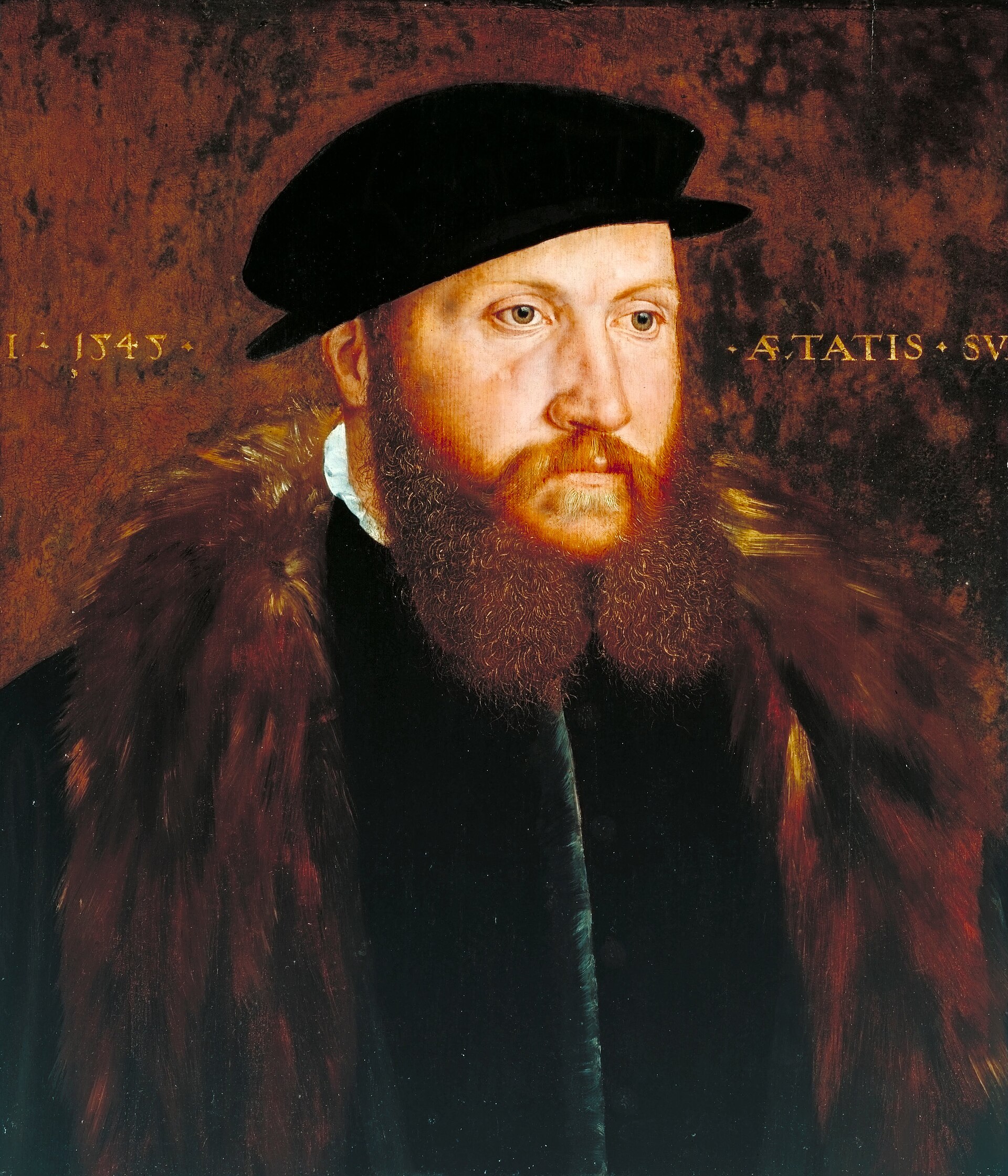
Exiles and Dynasties 1545–1640, Room 1 This is the oldest painting in Tate's collection — and it's a mystery.
A man in a black cap looks at us from the dark. He is twenty-six years old; we know that because the front of the panel records it, along with the date: 1545. The artist's name is written on the back. John Bettes the Elder, first recorded in 1531 doing decorative work for the court of Henry VIII — and he may have worked alongside Hans Holbein himself, which would explain the sharp, cool quality of this face.
But look at the background. It's brown, murky. It was once blue. The painting is on oak, and the blue pigment — smalt — has degraded over five centuries, turning from a bright field into this muddy glow. The portrait was also originally larger; it has been trimmed. So the picture you're looking at is not the picture that was painted. It's what time has left of it.
Bettes himself is barely visible in the record: a documented residence in Westminster in 1556; a mention in Foxe's Book of Martyrs of 1570 that refers to his death. That's almost everything we know about the man who made the oldest painting in this building.
Which is a perfect place to start a walk through five centuries: a face we can't identify, by a painter we can't follow, painted in colours we will never see as he saw them. Look at the eyes. He's watching us across half a millennium.
John Bettes the Elder, A Man in a Black Cap, 1545. Image: John Bettes the Elder via Wikimedia Commons (Public domain).
-
02Stop 2 of 12 · Exiles and Dynasties 1545–1640, Room 1
The Cholmondeley Ladies
Oil paint on wood
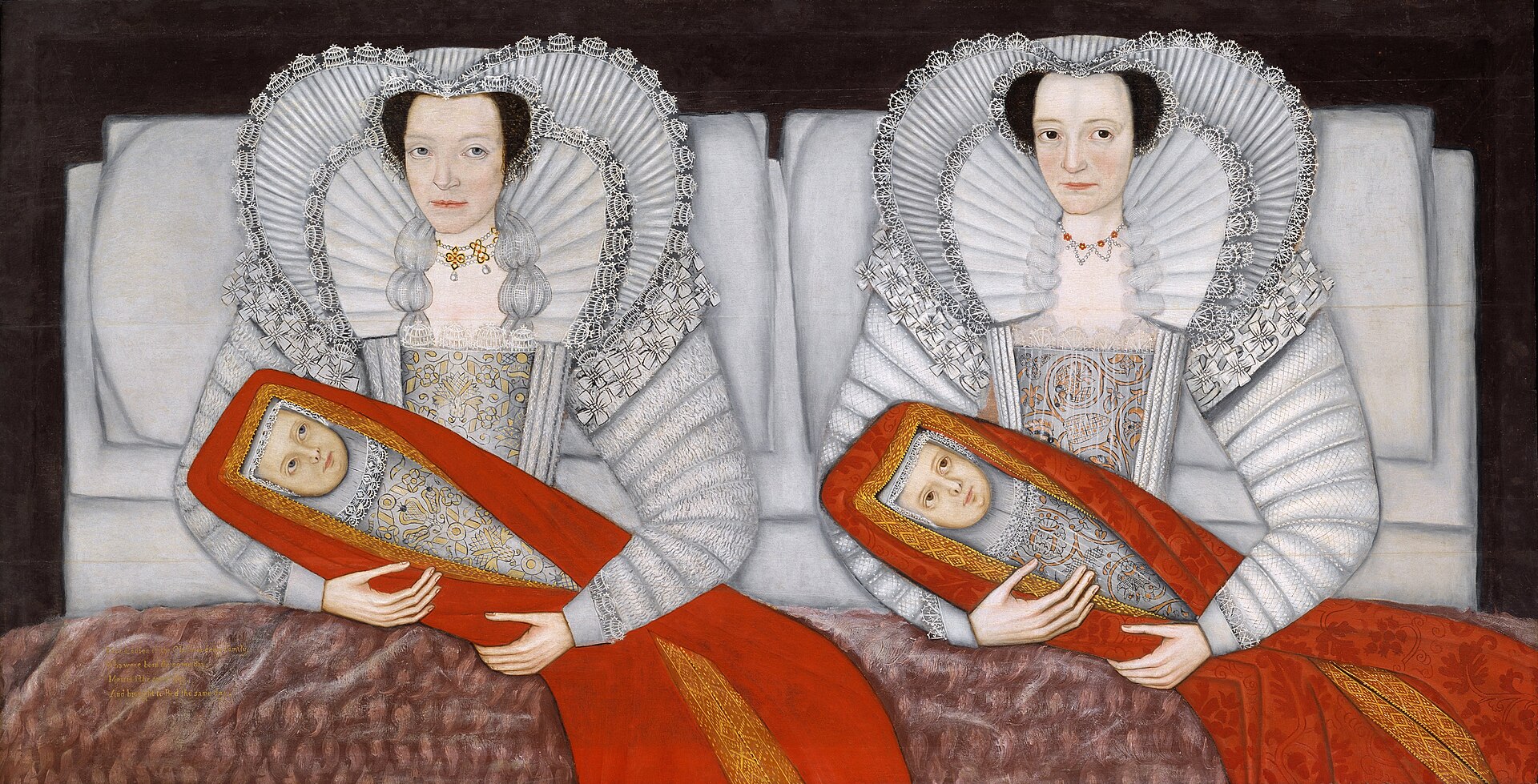
Exiles and Dynasties 1545–1640, Room 1 Two women sit up in bed with their babies, identical at a glance: same posture, same clothes, same scarlet-wrapped infants. And in gold lettering, the painting tells you a story. The two women were born the same day, married the same day, and brought to bed — gave birth — the same day.
The painting is from around 1600 or 1610, on four oak panels joined together, and nobody knows who painted it. Or, exactly, who they are. They may be two daughters of Sir Hugh Cholmondeley, Lettice Grosvenor and Mary Calveley — but the identification is uncertain.
What makes the picture so strange is its format. Two women sitting up in bed was how tomb sculpture showed the dead: recumbent, formal, side by side. Here, that funeral shape becomes a celebration of life — two births, one bed. But the mood hovers somewhere between the two.
And the closer you look, the less identical they become. The lace is different. The jewellery, the eye colours, even the infants — painted with the care of someone recording a real family, in a real house, on a very particular day.
This room, Exiles and Dynasties, is about a country finding its own image in the Tudor and Stuart centuries. And here is one of its quiet masterpieces: a painting about doubling, about family, about making sure that what happened was remembered.
Look from one face to the other. The painting wants you to look for the differences — that's the game it plays with you.
British School, The Cholmondeley Ladies, c.1600–10. Image: Anonymous Unknown author (British School, 17th century) via Wikimedia Commons (Public domain).
-
03Stop 3 of 12 · Metropolis 1720–1760, Room 3
The Painter and his Pug
Oil paint on canvas
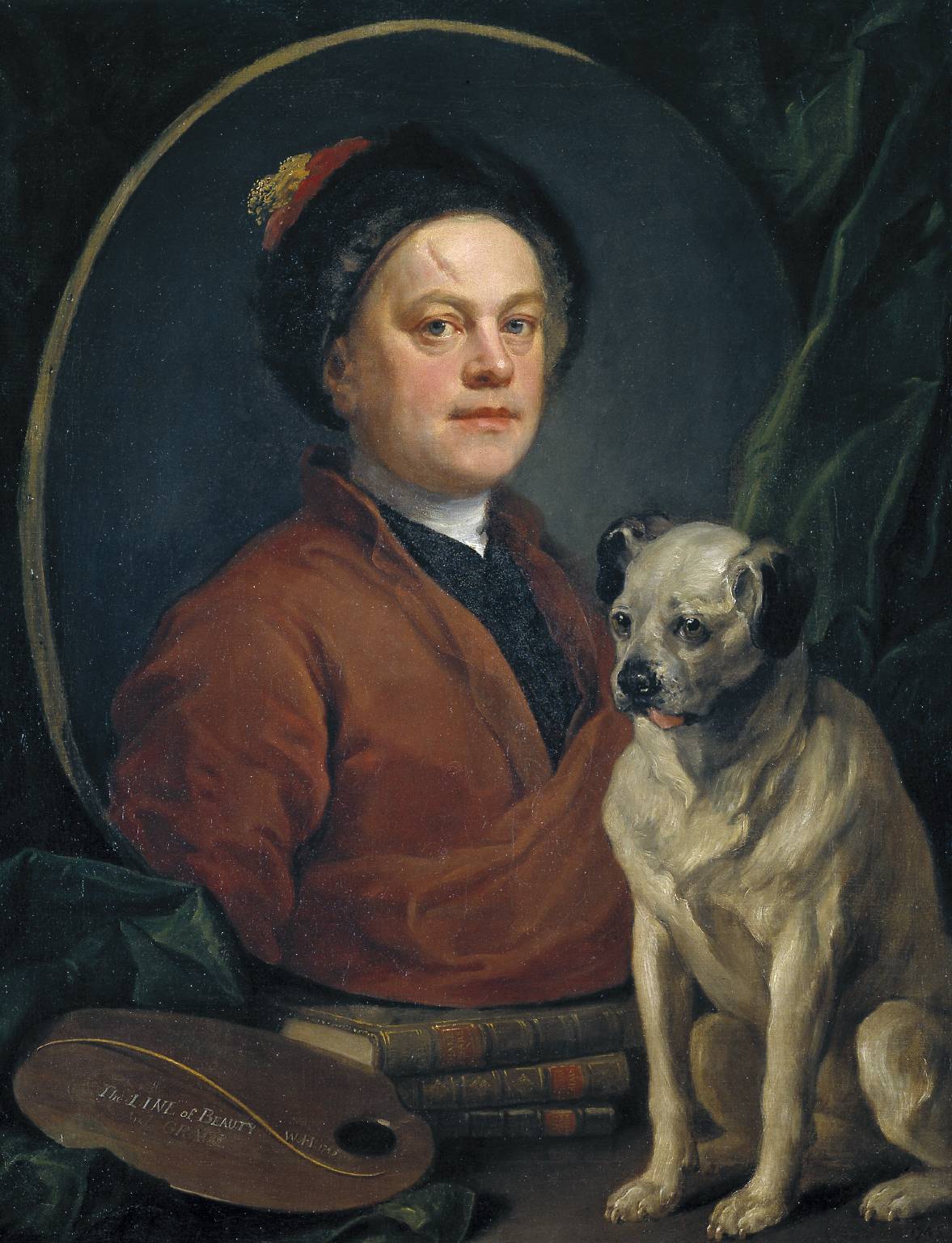
Metropolis 1720–1760, Room 3 A fat man leaning on a palette, a shelf, and — unmistakably — a pug.
William Hogarth painted himself here with his dog Trump. He began it around 1735 with serious intentions, planning a formal portrait in grand dress, and then, over the years, changed his mind: he repainted himself in informal clothes and let the dog stay. The result is one of the most human self-portraits in British art — a painter as a working man with his animal.
Look at the palette. Across it runs a wavy line: the Line of Beauty. Hogarth wrote a whole book arguing that the serpentine curve — the S-curve — is the root of beauty in art and nature, and here he signs his own face with the idea. The man is his own theory.
And there's a joke hidden in paint. The pug is painted with such rough, energetic realism that it seems more solid than its master. The cloth behind the dog's head even seems to break through the picture plane, as if the dog has jumped out of the world of the painting into ours.
Hogarth is the great origin point of a native British school — a painter who argued that London could make its own art, while the European stars, Canaletto included, were setting up shop in the same city.
This room is called Metropolis. Hogarth is its patron saint: satirist, class-traveller, showman. And this painting is the moment the British painter says: I'll paint myself exactly as I am — with the dog.
William Hogarth, The Painter and his Pug, 1745. Image: The Tate Britain via Wikimedia Commons (Public domain).
-
04Stop 4 of 12 · The Exhibition Age 1760–1815, Room 4
Three Ladies Adorning a Term of Hymen
Oil paint on canvas
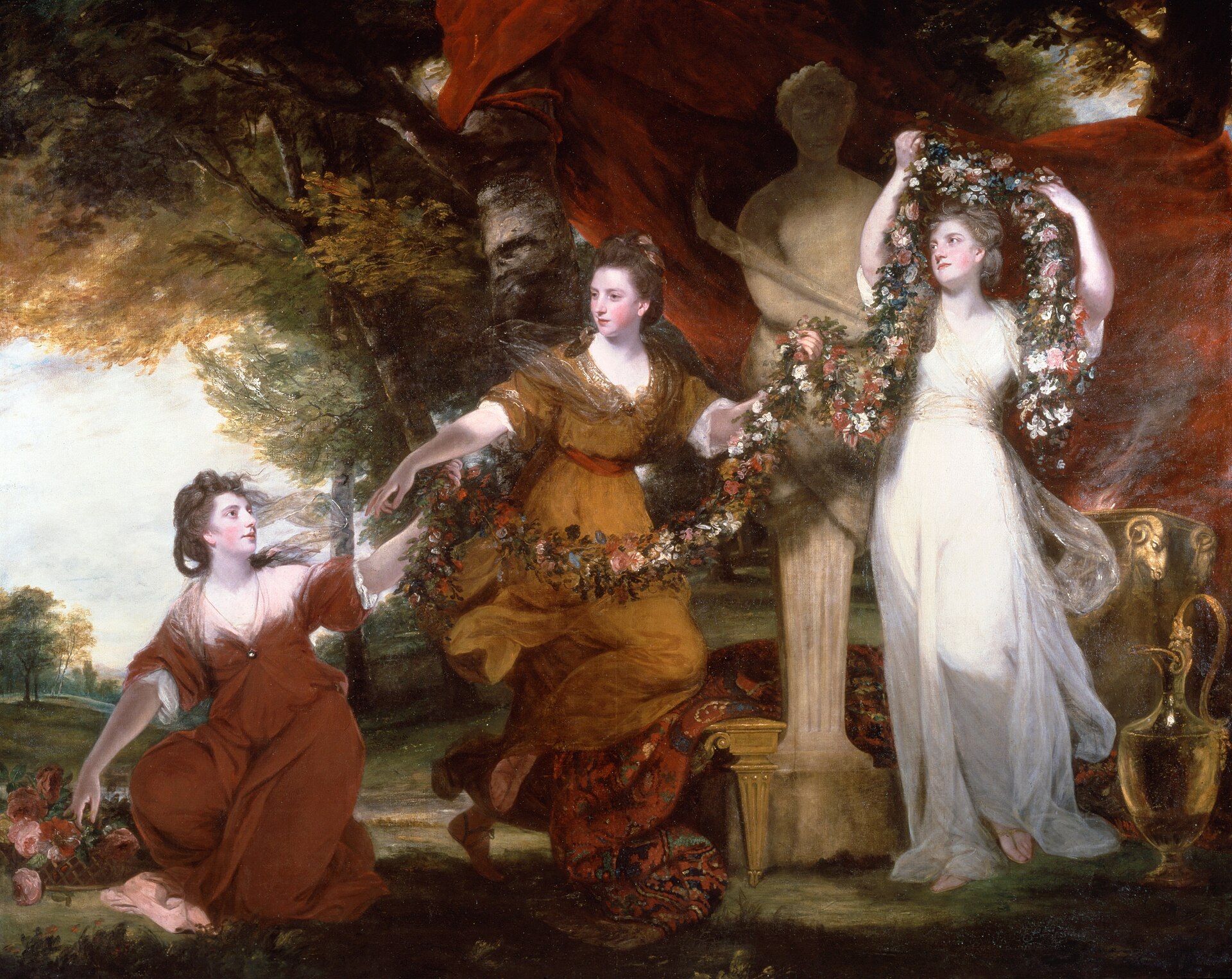
The Exhibition Age 1760–1815, Room 4 Three sisters garland a statue of Hymen, the god of marriage. Barbara, Elizabeth and Anne Montgomery — the daughters of Sir William Montgomery — were painted by Sir Joshua Reynolds, the first president of the Royal Academy, and the picture's nickname tells you everything about how it was received: The Irish Graces.
Reynolds was the great machine of 18th-century art: ambitious, theatrical, and unashamed to borrow from the old masters. Here he turns a portrait assignment for a marriageable family into something close to myth — the sisters dressed as classical figures, weaving flowers around a term.
It was shown at the Royal Academy exhibition of 1774 at Somerset House, part of the new culture of public exhibitions: paintings hung floor to ceiling, crowds, newspaper reviews, reputations made overnight. In 1837 it entered the National Gallery with the bequest of the Earl of Blessington, and eventually came here.
This room, The Exhibition Age, recreates the crowded, competitive hang of those shows. So imagine this painting surrounded by dozens of others, competing for attention — the way it was meant to be seen.
One lovely echo: sixty years later, John Singer Sargent quoted the composition for his own portrait of three sisters, The Acheson Sisters, which you'll hear about later on this walk. That's how British painting talks to itself across the centuries.
Look at the garland, then at the faces. The painting is about beauty, but it is also about property, inheritance and the marriage market. Both things are true.
Sir Joshua Reynolds, Three Ladies Adorning a Term of Hymen, 1773. Image: Joshua Reynolds via Wikimedia Commons (Public domain).
-
05Stop 5 of 12 · Troubled Glamour 1760–1830, Room 5
Haymakers
Oil paint on wood
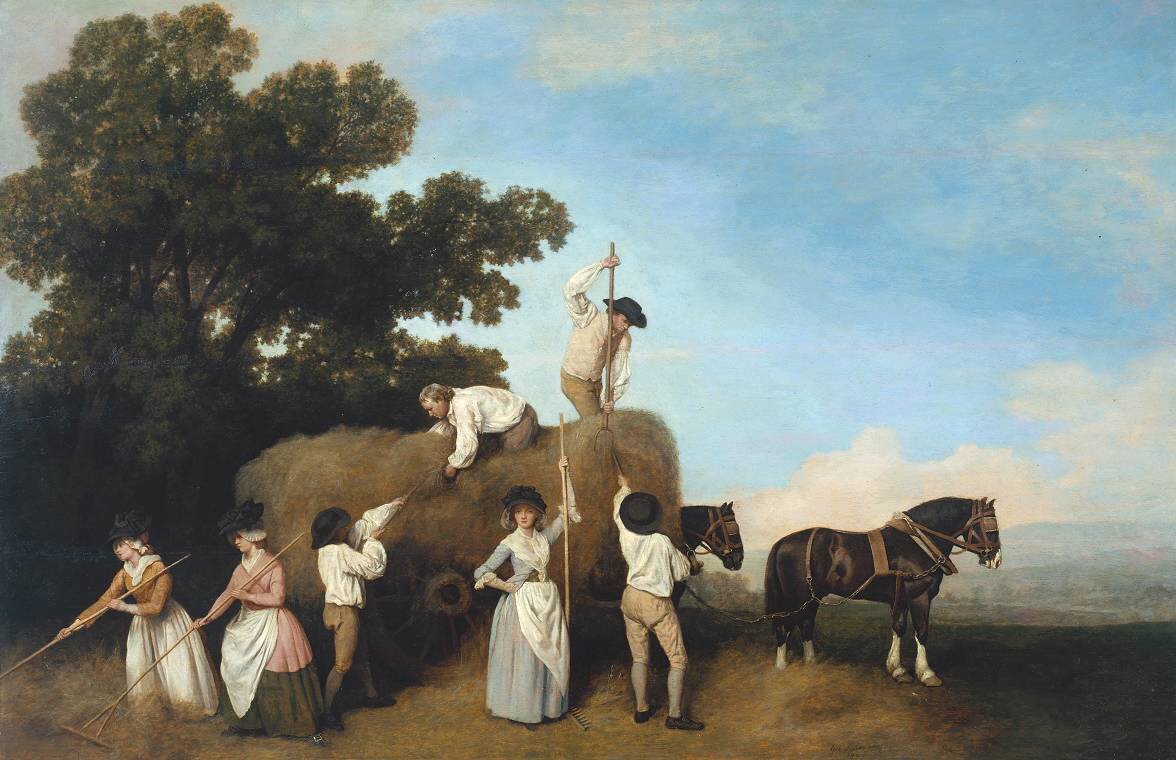
Troubled Glamour 1760–1830, Room 5 Haymakers — painted in 1785 by George Stubbs, the greatest horse painter of his age — and this picture is not really about hay at all.
It's a pair with its companion, Reapers, which hangs nearby. Together they do something very English: they take agricultural labour, back-breaking and endless, and turn it into calm.
Look at the workers. They're raking and gathering with real economy — Stubbs had a farm boy's eye, and the tasks are observed closely, the stacking, the raking, the horses. But the labourers themselves are serene, elegant, spotlessly clean. Nobody sweats. Nobody drinks from a jug on their knees. The image is what it needs to be for the people who bought it: a reassuring picture of the countryside for wealthy urban patrons.
Agricultural efficiency was the hot subject of the decade. A growing, increasingly urban country needed feeding, and the fields were being reorganised — enclosures, machinery, processes that transformed rural lives for good and for ill. In the companion painting, Reapers, you can even spot a farm manager on horseback among the stubble: authority, watching the work.
That's the trick of pictures like this. It's not a lie exactly — the fields were real. But it's a view from a window, chosen by the window-owner.
This room is Troubled Glamour: an age of elegance with something uneasy underneath. Look at the haymakers and ask: for whose benefit are they so calm?
George Stubbs, Haymakers, 1785. Image: George Stubbs via Wikimedia Commons (Public domain).
-
06Stop 6 of 12 · Revolution and Reform, Room 6
The Ghost of a Flea
Tempera and gold on mahogany
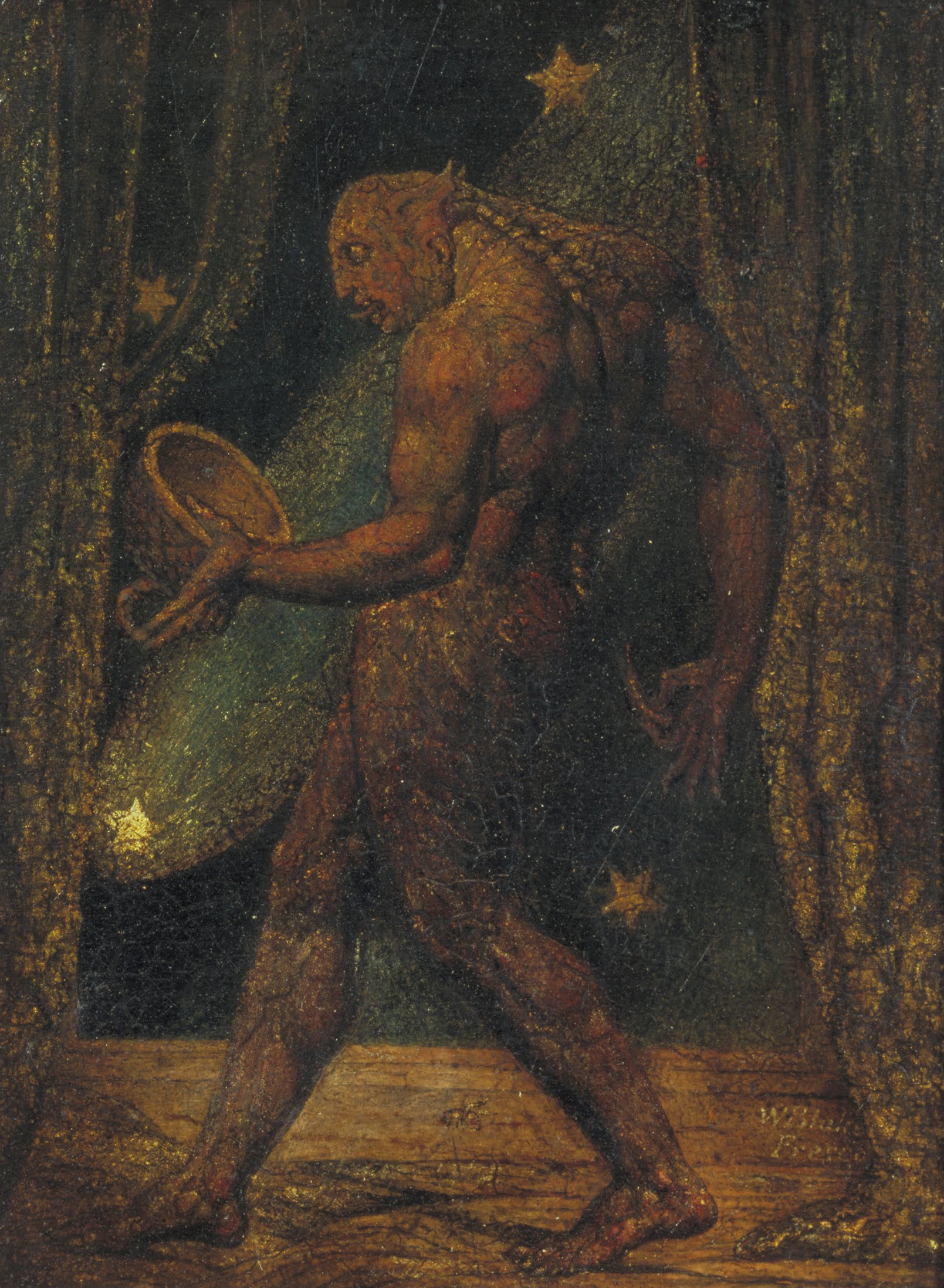
Revolution and Reform, Room 6 A muscular monstrous body, seated alone in the dark, staring at something outside the picture. It is 21 centimetres tall — smaller than a sheet of paper — and it is the Ghost of a Flea.
William Blake completed it around 1819 or 1820, in tempera and gold on a mahogany panel, as part of the so-called Visionary Heads: a set of portraits of imaginary and spirit subjects made for his friend, the watercolourist and astrologer John Varley.
The sessions went like this. Late at night, at Varley's house, the occult show would begin. Varley would name a figure from history or the spirit world; Blake — who said he saw visions daily — would describe it, then sketch what he saw. The flea arrived as a spirit with a personality: cruel, human-like, working for the great rulers of the insect world. Blake painted it with the scale of a Roman statue and the body of a weightlifter.
And this strange image is a doorway in this route. Around 1770 to 1830, Britain was deep into ghosts, spirits, medieval revivals and the supernatural — the age of the Gothic novel, of satanic poems and visionary painters. Blake is the deepest end of it: a poet and engraver who saw the world as a system of energies, and refused to make pictures the way the Academy wanted.
Stand close. It's small, but it is not minor. It's monumental in imagination — and nearly two centuries later, it still feels like something you weren't supposed to see.
William Blake, The Ghost of a Flea, c.1819–20. Image: William Blake via Wikimedia Commons (Public domain).
-
07Stop 7 of 12 · Life and Liberty, Room 7
The Death of Major Peirson, 6 January 1781
Oil paint on canvas
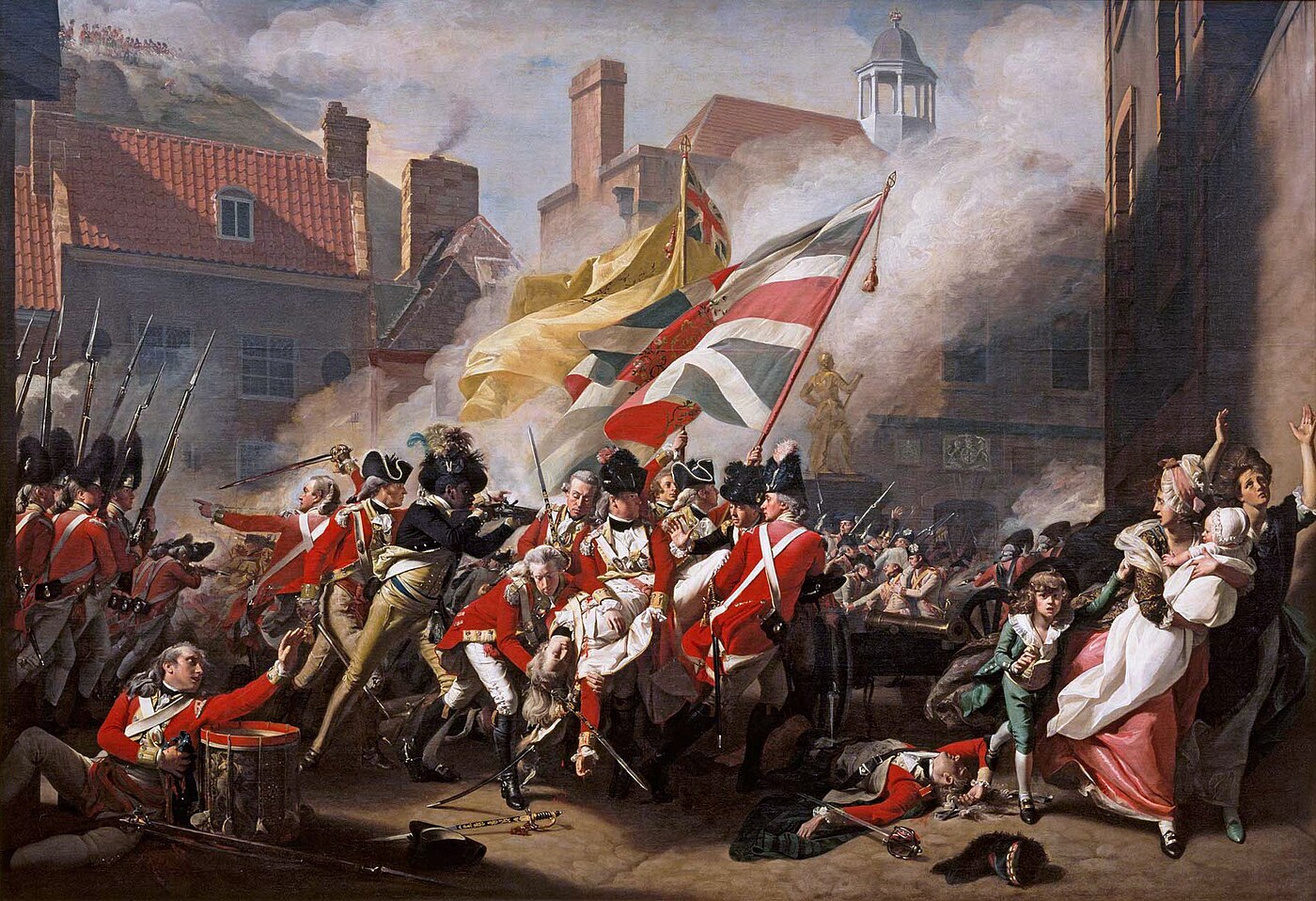
Life and Liberty, Room 7 The Battle of Jersey, the 6th of January 1781. The last French attempt to seize the island — and one of the last battles by invading forces on the British Isles themselves.
Around a thousand French soldiers under Baron de Rullecourt landed overnight and captured St Helier. The Lieutenant Governor, Moses Corbet, was taken and surrendered. But a twenty-four-year-old officer, Major Francis Peirson, refused the surrender and ordered his troops to counter-attack. Somewhere in the crossfire, Peirson was shot dead. A Jersey officer, Lieutenant Dumaresq, took command — and the British forces, including the 78th Highlanders and the island militia, overwhelmed the French within hours.
Copley's painting is the death moment: Peirson falling, his men in fury, the town behind. The picture you see here places Peirson's servant shooting at a sniper from the window. Liberty, loyalty, sacrifice — painted as a modern event, not a myth.
That's the ambition. Copley was following Benjamin West's idea of painting recent history with the seriousness of ancient history — not gods and emperors, but a battle that readers of the newspapers knew about, with heroes they could recognise.
This is the featured work of the Life and Liberty room, and it is propaganda, yes — but it's propaganda in the service of an argument about what liberty costs. Look at the clash in the centre: the young man down, the flag up. That is how a nation teaches itself to remember its wars.
John Singleton Copley, The Death of Major Peirson, 6 January 1781, 1782–4. Image: John Singleton Copley via Wikimedia Commons (Public domain).
-
08Stop 8 of 12 · Art for the Crowd 1815–1905, Room 8
The Great Day of His Wrath
Oil paint on canvas
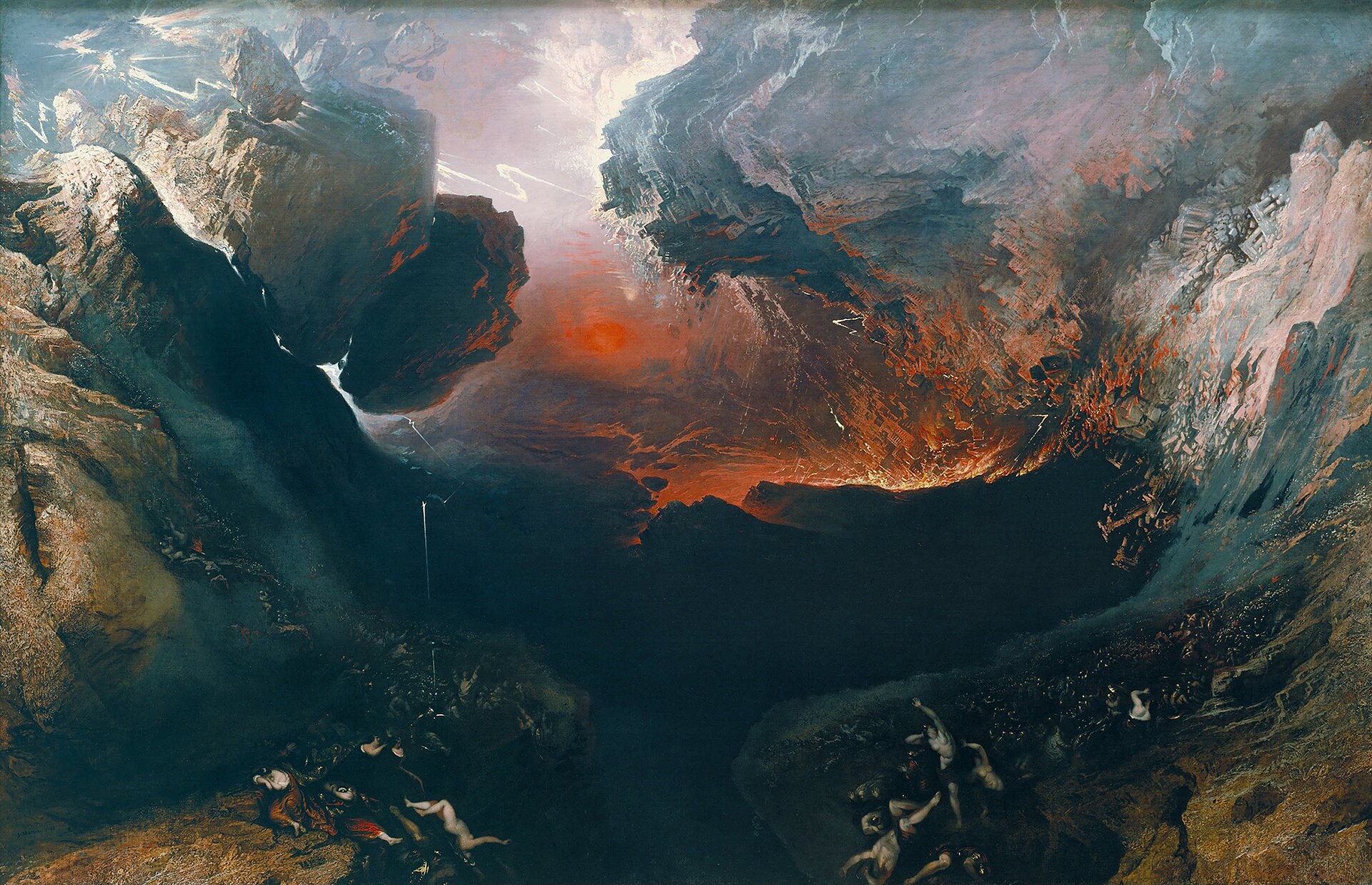
Art for the Crowd 1815–1905, Room 8 Now step into Art for the Crowd, and hold on to something.
A city is being annihilated. The earth splits, buildings tumble into a glowing abyss, and the sky is a funnel of fire. This is the Great Day of His Wrath, the Last Judgement as an earthquake, painted by John Martin between 1851 and 1853.
Martin was the great showman of catastrophe. His son Leopold said the idea came to him on a night journey through the Black Country — the industrial landscape of furnaces and slag heaps lit red by night. Scholars have traced the collapsing city to Edinburgh: Calton Hill, Arthur's Seat and the Castle Rock, tumbling into the valley. Either way, the painting is about a world ending — Babylon, the material city, brought down by its own gravity.
And the appetite for this was real. In the 1820s and 30s, Britain was flooded with prints, panoramas, broadsheets and spectacles of disaster. Apocalypse was popular entertainment — catastrophe you could buy a ticket to. Martin, a painter from Newcastle with a theatrical streak, painted it at monumental scale and sold it as a showpiece.
Tate hangs him here in Art for the Crowd, among the Victorian spectacles he was competing with. And that's the right place for him: the man ruined by the art market, who kept painting the end of the world.
Look at the tiny figures swept into the gulf. Martin's trick is scale: the bigger the painting, the smaller you feel. And the small figures seem to be — going where?
John Martin, The Great Day of His Wrath, 1851–3. Image: John Martin via Wikimedia Commons (Public domain).
-
09Stop 9 of 12 · Art for the Crowd 1815–1905, Room 8
Carnation, Lily, Lily, Rose
Oil paint on canvas
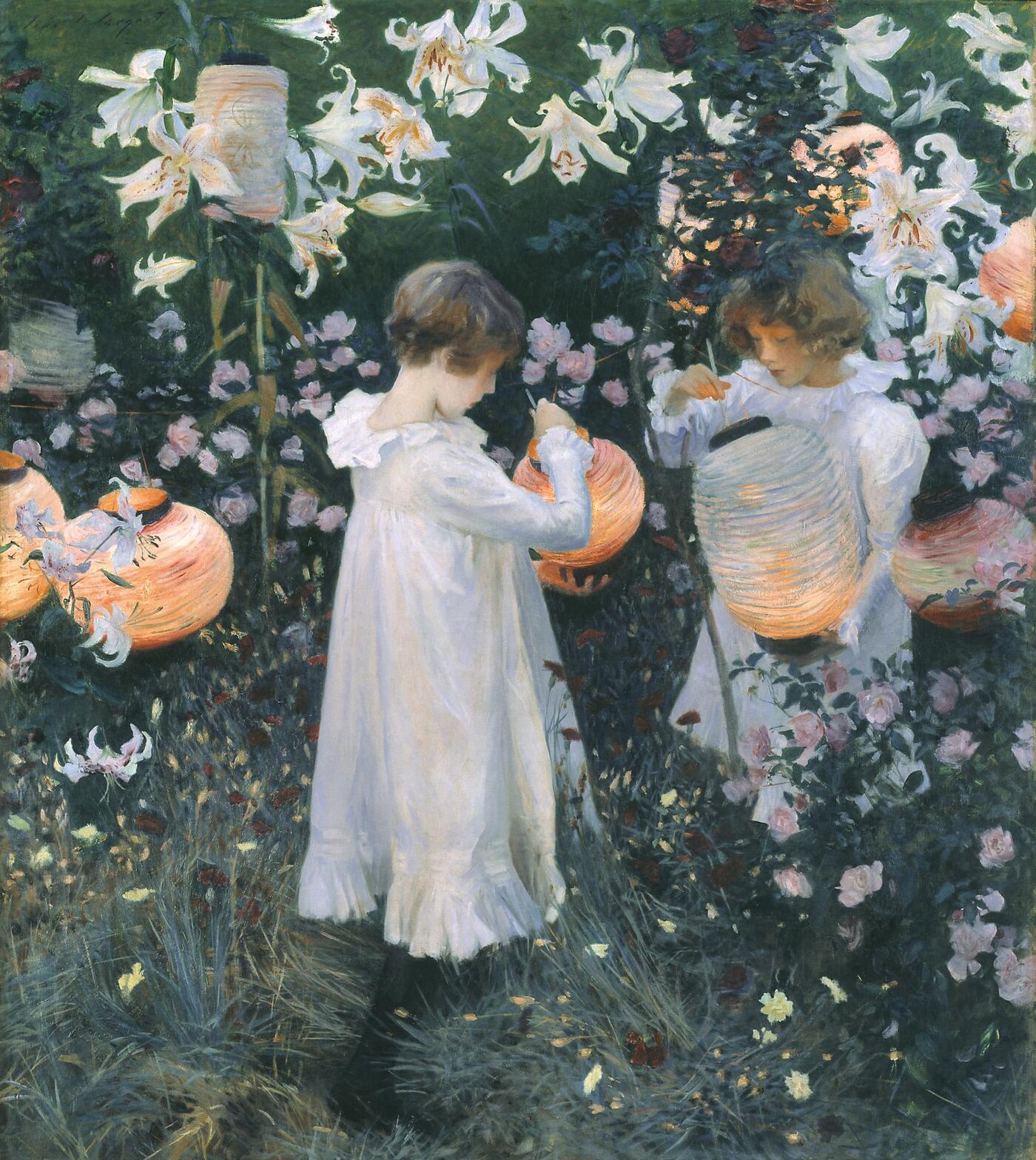
Art for the Crowd 1815–1905, Room 8 Carnation, Lily, Lily, Rose — the title comes from the refrain of a popular song, and the painting floats like one.
In the autumns of 1885 and 1886, John Singer Sargent worked in the garden of a house at Broadway in the Cotswolds, painting two little girls — Polly and Dorothy Barnard, the daughters of the illustrator Frederick Barnard — lighting Japanese lanterns among the flowers. He could only work for a few minutes each evening: the painting needed the exact instant of dusk, pink sky, lanterns just lit, neither day nor night.
Sargent had left France after the scandal of his Portrait of Madame X — too daring, too modern for Paris society — and come to England, where a circle of artists and writers gathered at Broadway, including Robert Louis Stevenson. This picture was his English recovery: the painter of the shocking, the sudden, painting bliss.
Look at what he did with the canvas. He cut about two feet off the left-hand side while working, cropping it into the near-square shape you see now — the picture was still teaching him what it wanted to be.
And notice the flowers and the light. The whole thing is extraordinarily decorative — a garden that exists to be painted. But the girls are real children concentrating on real matches and real lanterns. It's the moment British painting learned from France, and forgave itself for it.
Stand back. It's dusk. Let it glow.
John Singer Sargent, Carnation, Lily, Lily, Rose, 1885–6. Image: Multiple Aurthors via Wikimedia Commons (CC0).
-
10Stop 10 of 12 · A Room of One's Own 1890–1915, Room 12b
Ennui
Oil paint on canvas
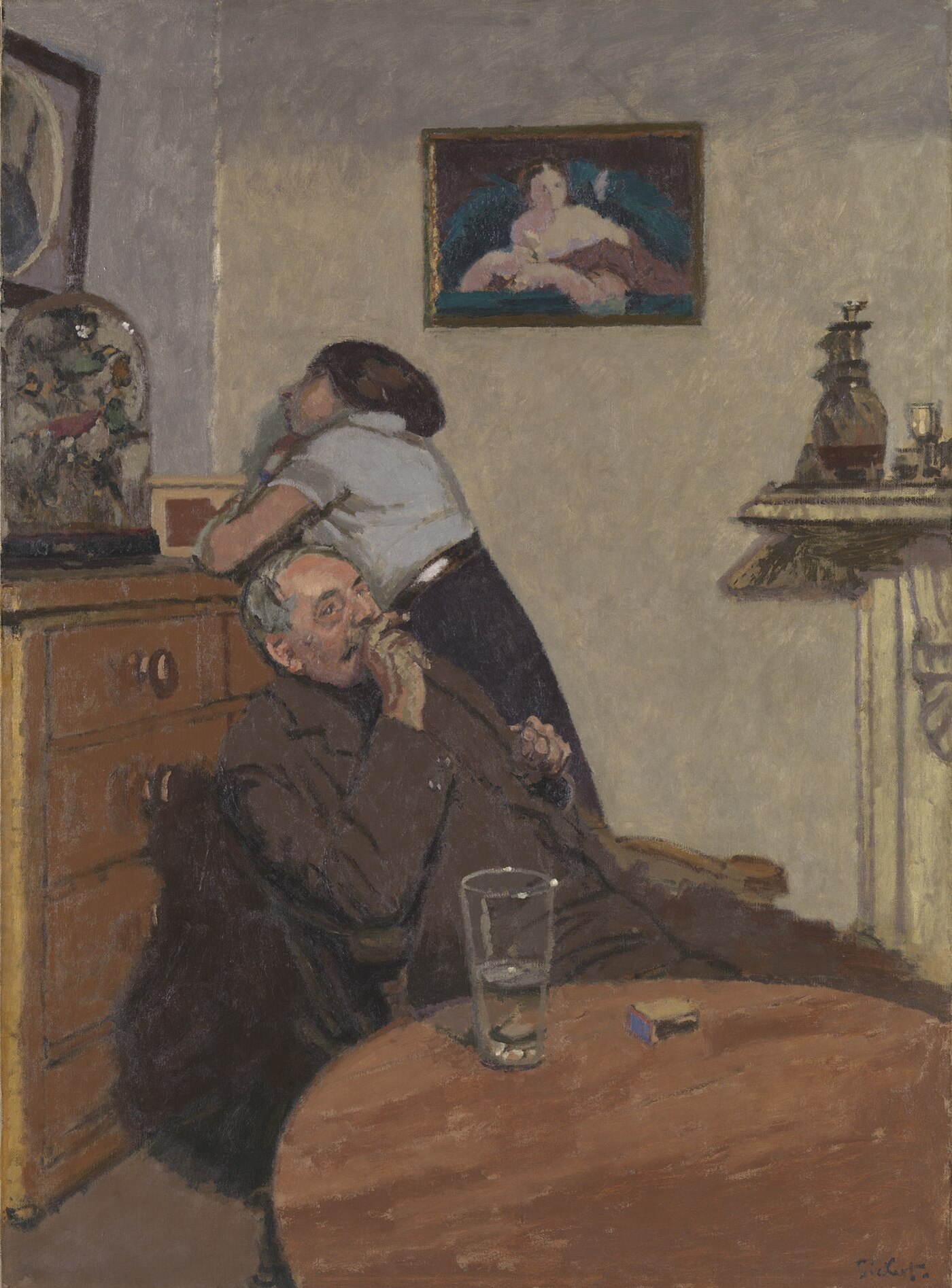
A Room of One's Own 1890–1915, Room 12b Ennui. French for boredom. Walter Sickert gave the picture its title himself, and it is probably his most famous work.
A man and a woman sit in a small room, close together, and impossibly far apart. They face in opposite directions, staring into nothing. The room is dark, filled with heavy old furniture, musty pictures, a shell souvenir, and a glass dome with stuffed birds in it — a bell jar that says everything about the atmosphere: life, preserved and suffocated.
Sickert prepared the composition like a film director: he posed his own maid, Mary, and an old friend nicknamed Hubby for a photograph, then painted from the photograph. That's an astonishingly modern way to work in 1914, and Sickert had learned it partly from his mentor, James McNeill Whistler, and from the new age of the camera. At least five versions of the painting exist; he kept replaiting the same scene.
And notice what he refuses to give you: a moral. There is no story here about who these two are, or why they are trapped, or who is to blame. Tate's label leaves the interpretation to you. Is it a marriage? A brothel? A boarding house? Sickert, who had painted murders and music halls, knows exactly how much to withhold.
This room, A Room of One's Own, covers 1890 to 1915 — the generation finding its own spaces. Ennui is the inside of one of those rooms: the sound of nothing happening.
Look at the bell jar, and the two directions their eyes are going.
Walter Sickert, Ennui, c.1914. Image: Walter Sickert via Wikimedia Commons (Public domain).
-
11Stop 11 of 12 · JMW Turner | Travels in Europe, Room 37
The Dogana, San Giorgio, Citella, from the Steps of the Europa
Oil paint on canvas
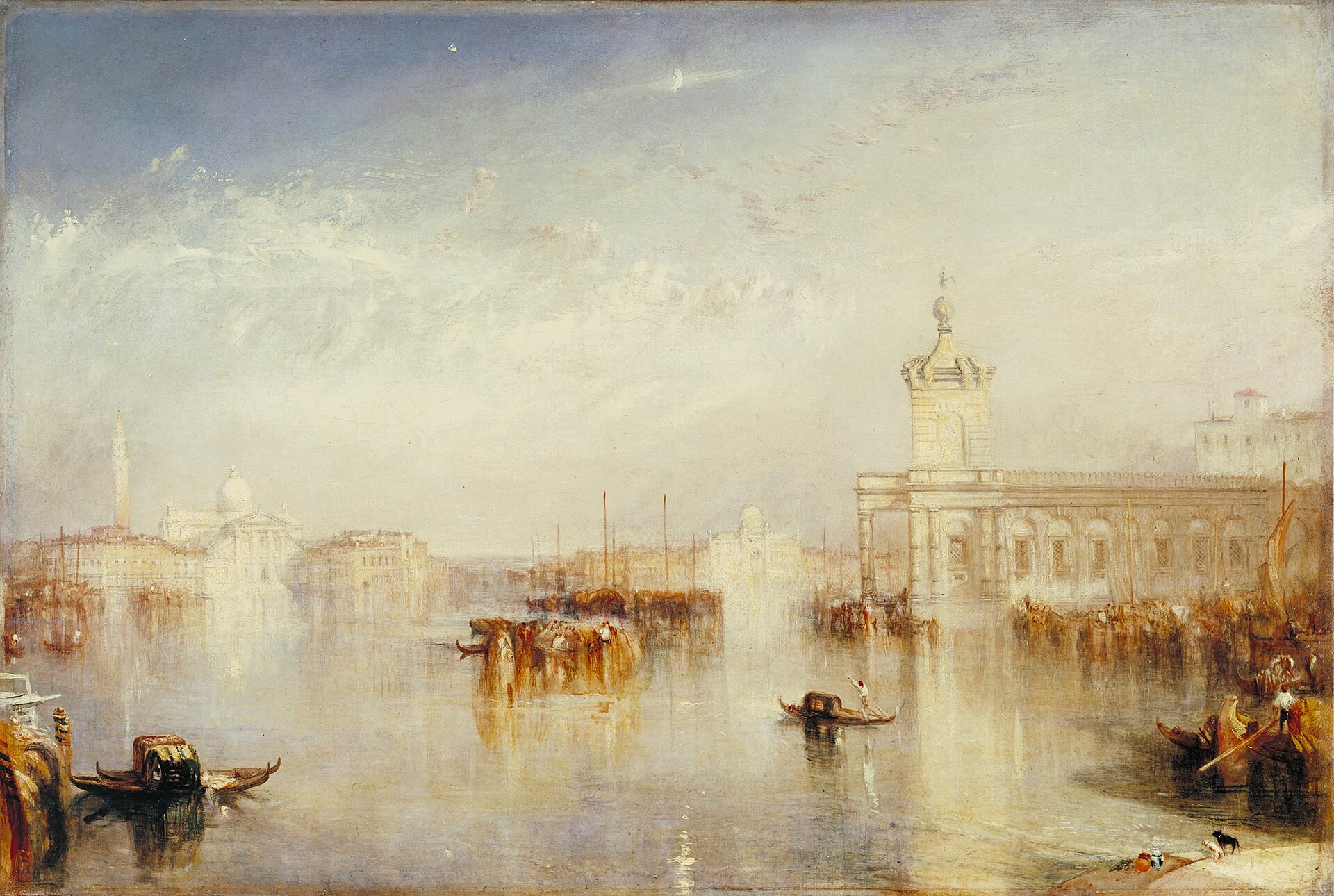
JMW Turner | Travels in Europe, Room 37 Before you finish, walk on into the Clore Galleries — the Turner wing — for the coda. Two landscape masters, two ways of looking at Britain.
This one is Turner in Venice. The Dogana — the customs house — with San Giorgio across the water, painted from the steps of the Hotel Europa, where he used to stay as a guest of the manager. He exhibited it at the Royal Academy in 1842.
Notice how modest it is, next to the great storms he painted. Small canvas, middle-class customer, Venice — the city that had become fashionable after Byron, the destination for the new travelling public. Turner loved Venice as a subject for the same reason he loved storms: both dissolve into light. Here, haze eats the architecture; the water and buildings almost merge.
It was bought immediately in 1842 by the collector Robert Vernon, and given to the nation in 1847 — the Vernon Gift — one of the earliest great acts of public collecting in this country.
And this little canvas holds a whole turn in Britain's self-image. The country that once painted itself as kings and battles now paints moments of travel, leisure and atmosphere — places to be, on holiday. Turner didn't just paint the sea. He painted the world the way a modern person sees it: in passing, from a boat, with the light changing.
Look at the space between the customs house and the church. That's not empty water. That's the subject.
Sources- tate.org.uk/art/artworks/turner-the-dogano-san-giorgio-citella-from-the-steps-of-the-europa-n00372
- tate.org.uk/visit/tate-britain/display/jmw-turner/travels-in-europe
- tate.org.uk/art/artists/joseph-mallord-william-turner-558
- en.wikipedia.org/wiki/The_Dogano,_San_Giorgio,_Citella,_from_the_Steps_of_the_Europa
J.M.W. Turner, The Dogana, San Giorgio, Citella, from the Steps of the Europa, exhibited 1842. Image: J. M. W. Turner via Wikimedia Commons (Public domain).
-
12Stop 12 of 12 · JMW Turner | Constable 'Six Footers', Room 38
Salisbury Cathedral from the Meadows
Oil paint on canvas
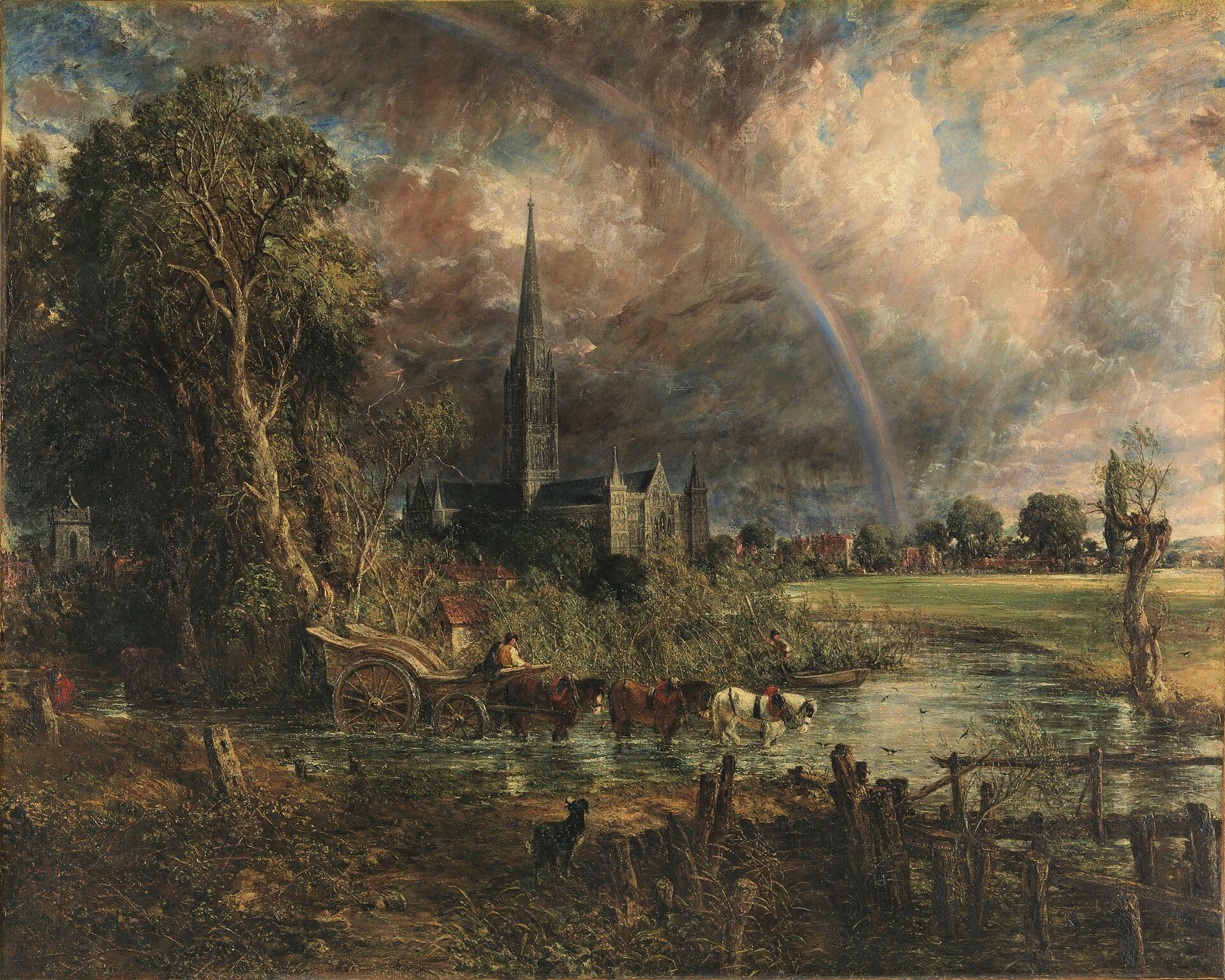
JMW Turner | Constable 'Six Footers', Room 38 And here — the finale. Salisbury Cathedral from the Meadows, painted by John Constable in 1831, and considered by the painter himself to be his finest work.
Constable had married Maria Bicknell in 1816, against the wishes of her family. She died in 1828, leaving seven children. The painting is a year or so after her death, and the sky above the cathedral is everything: storm clouds breaking, a rainbow trembling over the water, the cathedral seen from across the meadows under a wind that seems about to change the world.
Constable added nine lines from Thomson's poem The Seasons, which turn the rainbow into an image of hope after grief. But the turbulence in the sky wasn't painted from a poem — it's the emotional weather of a man who had lost his wife, insisting on beauty anyway.
He first visited Salisbury in 1811 as the guest of the bishop, and became close friends with the Reverend John Fisher, who lived at the cathedral close. Of Fisher, Constable wrote simply: 'We loved each other.' So here are both loves, landscape and friendship, gathered in one painting.
It was exhibited at the Royal Academy in 1831 but Constable kept working on it. You may find you keep working on it too.
Stand back from the cathedral. Watch the rainbow settle over the meadows, and ask what British painting came to love: not power, not myth — weather, home, and the changing light. That's five centuries, ending in a meadow. Thank you for walking with me.
Sources- tate.org.uk/art/artworks/constable-salisbury-cathedral-from-the-meadows-t13896
- tate.org.uk/art/artworks/constable-salisbury-cathedral-from-the-meadows-t13896/in-depth-salisbury-cathedral-from-the-meadows
- tate.org.uk/art/artists/john-constable-108
- en.wikipedia.org/wiki/Salisbury_Cathedral_from_the_Meadows
John Constable, Salisbury Cathedral from the Meadows, 1831. Image: John Constable via Wikimedia Commons (Public domain).
More routes
-
0112 stops · about 90 min
Pre-Raphaelites: Truth & Beauty
The Brotherhood that painted every leaf and refused to flatter: love, conscience and legend in Victorian Britain.
-
0211 stops · about 90 min
Turner: Light, Sea, Storm
Fifty years of Turner — from a moonlit debut to canvases left unfinished: sea, storm and light.
Stay in the loop
Want to know when a new museum or route is covered? Leave your email and we'll write when the next guide is ready — nothing else, ever.
No spam. Unsubscribe any time.