Tate Britain · 12 stops · about 90 min
Pre-Raphaelites: Truth & Beauty
The Brotherhood that painted every leaf and refused to flatter: love, conscience and legend in Victorian Britain.
Millais, Rossetti, Hunt, Burne-Jones — about ninety minutes · displays checked 2026-10-03
-
01Stop 1 of 12 · Historic and Modern British Art | Beauty and Protest 1845-1905 (Room 10)
Christ in the House of His Parents (The Carpenter's Shop)
Oil paint on canvas
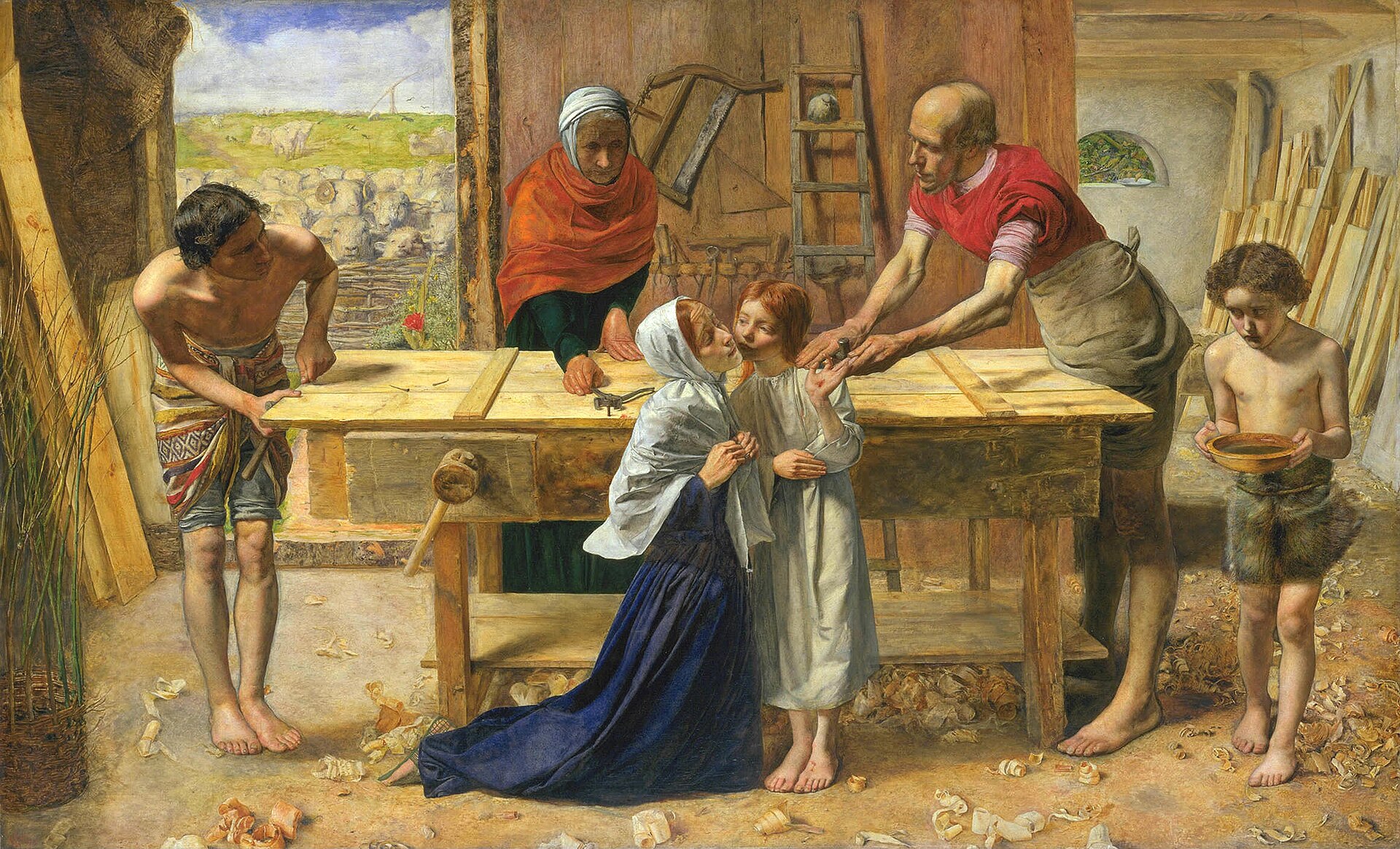
Historic and Modern British Art | Beauty and Protest 1845-1905 (Room 10) Look first at the hands of the boy in the centre. He's cut his palm on a nail, and the wound is bleeding. Behind him, an older man bends over his workbench — and the boy's foot, resting on the floor, is marked with blood too.
This is the holy family, painted as though the Bible had happened next door. Millais was twenty years old. He set the scene in a real carpenter's shop, filled with real shavings and sawdust, and he loaded it with signs of what is coming: the wood, the nails, the cut hand, the blood. Through the doorway you can see sheep — the flock — and a single dove. Young John the Baptist carries a bowl of water, preparing the way.
Millais exhibited the picture with a verse from the Old Testament: "And one shall say unto him, What are these wounds in thine hands? Then shall he answer, Those with which I was wounded in the house of my friends."
London hated it. The press called the picture blasphemous and vulgar. Charles Dickens wrote that the boy Christ was "a hideous, wry-necked, blubbering, red-haired boy in a night-gown." Queen Victoria, hearing the fuss, asked for the painting to be brought to her privately, to see for herself.
It didn't matter that the critics sneered. Everyone was talking. The Pre-Raphaelite Brotherhood had arrived — and it arrived here, in this room, in a carpenter's shop.
Look closer at the boy's face. He's not radiant. He's ordinary, and he already knows what's coming.
John Everett Millais, Christ in the House of His Parents (The Carpenter's Shop), 1849–50. Image: John Everett Millais via Wikimedia Commons (Public domain).
-
02Stop 2 of 12 · Historic and Modern British Art | Beauty and Protest 1845-1905 (Room 10)
Ecce Ancilla Domini! (The Annunciation)
Oil paint on canvas
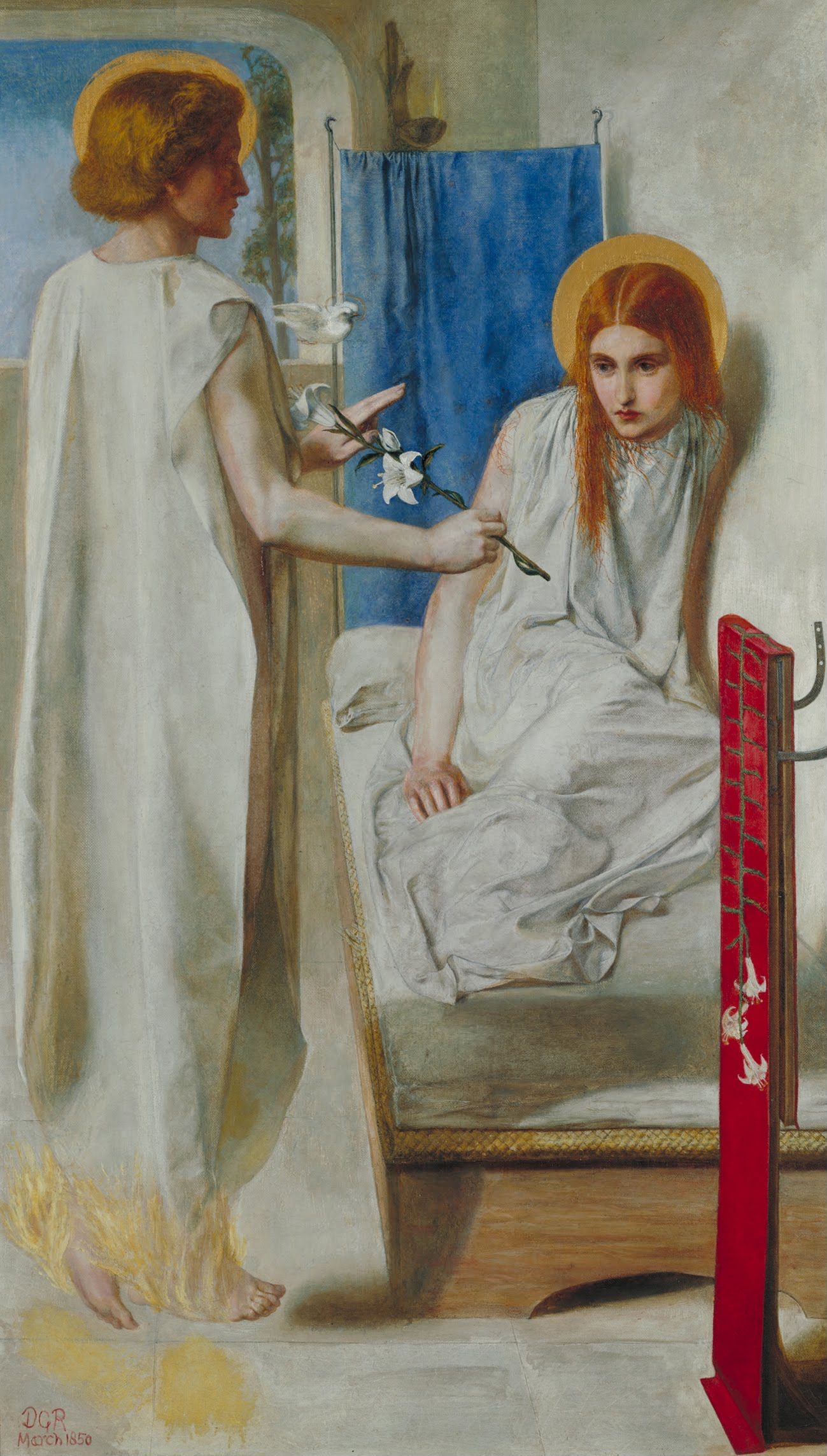
Historic and Modern British Art | Beauty and Protest 1845-1905 (Room 10) The Annunciation — the moment the angel Gabriel tells Mary she will bear the Christ child. Painters had pictured it for centuries, always in the same way: Mary kneeling, composed, golden light, folded hands.
Rossetti throws all of that out. Here she is in bed. Woken. Sitting up in a plain white shift, pressed back against the wall, eyes wide. The angel is close — too close — holding out a lily, the flame of life at his feet. And the face of Mary is that of Rossetti's sister, the poet Christina Rossetti, who was sitting for him at home.
The colour is deliberately narrow: whites, pale blues, a thread of red. The mood isn't glory. It's dread. Rossetti is reading the story psychologically — what must it be like to be told you will carry a god, whether you like it or not?
The Latin title, Ecce Ancilla Domini, comes from the Gospel of Luke: "Behold the handmaiden of the Lord."
It was exhibited in 1850 at the Old Portland Gallery on Regent Street, and met the same wall of mockery as the carpenter's shop. It sold for fifty pounds in 1853. It took until 1886 for the nation to buy it for the Tate.
Compare it with the picture you just saw. Same cause, two completely different temperaments: Millais, looking outward at real flesh and real wood; Rossetti, looking inward, at an inner life trembling.
Look closely at Mary's hands and shoulders. The whole drama is in the shrinking of her body.
Dante Gabriel Rossetti, Ecce Ancilla Domini! (The Annunciation), 1849–50. Image: Dante Gabriel Rossetti via Wikimedia Commons (Public domain).
-
03Stop 3 of 12 · Historic and Modern British Art | Beauty and Protest 1845-1905 (Room 10)
Ophelia
Oil paint on canvas
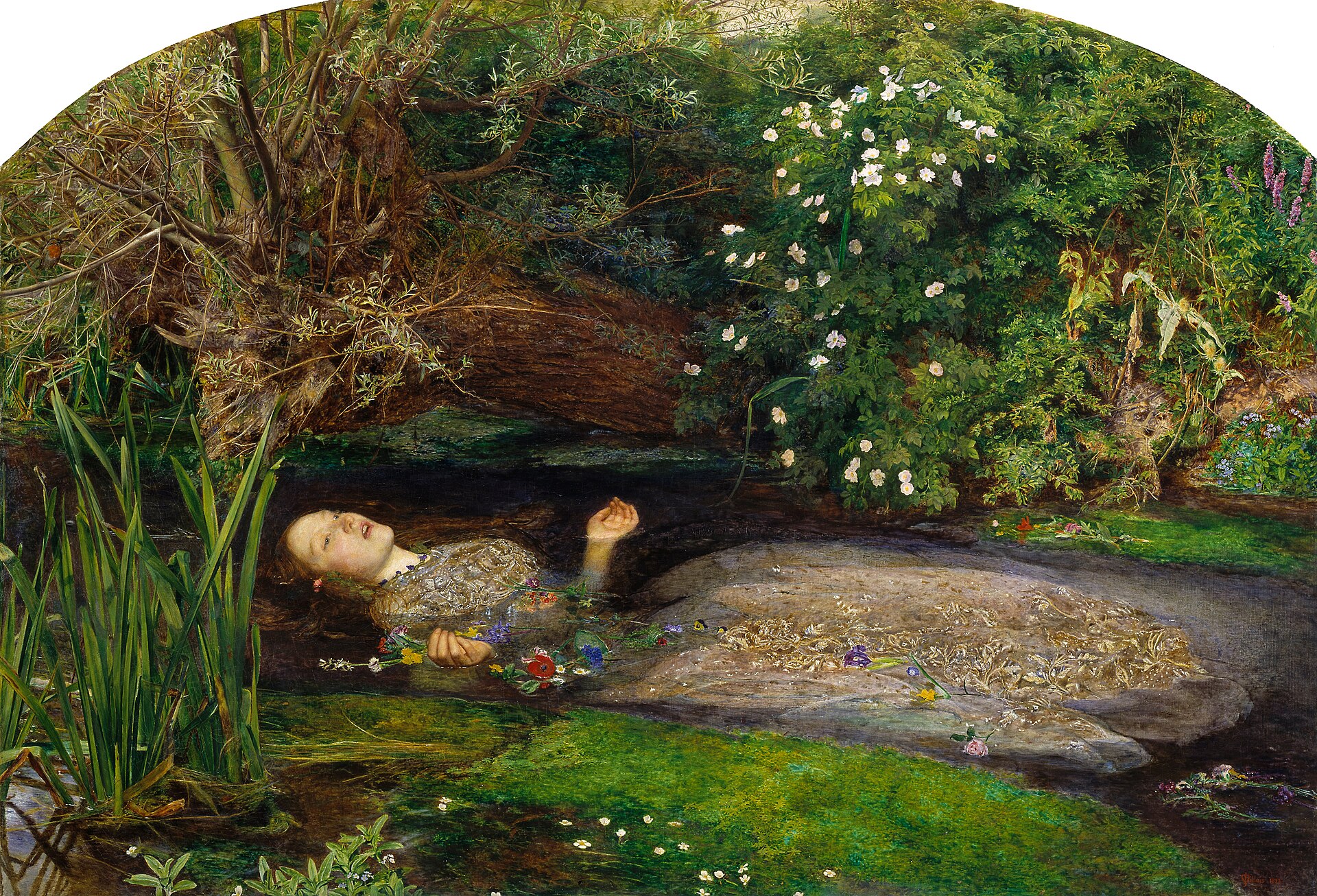
Historic and Modern British Art | Beauty and Protest 1845-1905 (Room 10) If you know one Pre-Raphaelite painting, it's probably this one. Ophelia, from Hamlet: the young woman who, driven mad by grief, falls into a river while picking flowers, and drowns, singing. Shakespeare gives her death to Queen Gertrude to describe — we never see it on stage. Millais makes us watch.
He painted the riverbank from life, on the Hogsmill River at Ewell in Surrey, standing outdoors hour after hour, chasing particular weather and particular leaves. The figure he painted indoors, in a studio in Gower Street, with Elizabeth Siddal lying in a bath of water while oil lamps underneath kept it warm.
One day the lamps went out, and Millais — absorbed in his work — painted on. Siddal caught a chill that turned into a serious illness. She was paid, in the end, with the doctor's bill.
The willow leaning over Ophelia is the symbol of forsaken love. The flowers are all real, and many have meanings: pansies for thought, violets for faithfulness, poppies for sleep. Her open hands, her calm face, half under the water, make drowning look almost gentle — which is exactly what disturbed the first viewers at the Royal Academy.
Today his drowning Ophelia is the most popular work in the Tate.
Don't just look at her. Look at the leaves — painted one at a time, from life, because that was the whole point of the Brotherhood. And then look back at her face.
John Everett Millais, Ophelia, 1851–2. Image: John Everett Millais via Wikimedia Commons (Public domain).
-
04Stop 4 of 12 · Historic and Modern British Art | Beauty and Protest 1845-1905 (Room 10)
Our English Coasts, 1852 ('Strayed Sheep')
Oil paint on canvas
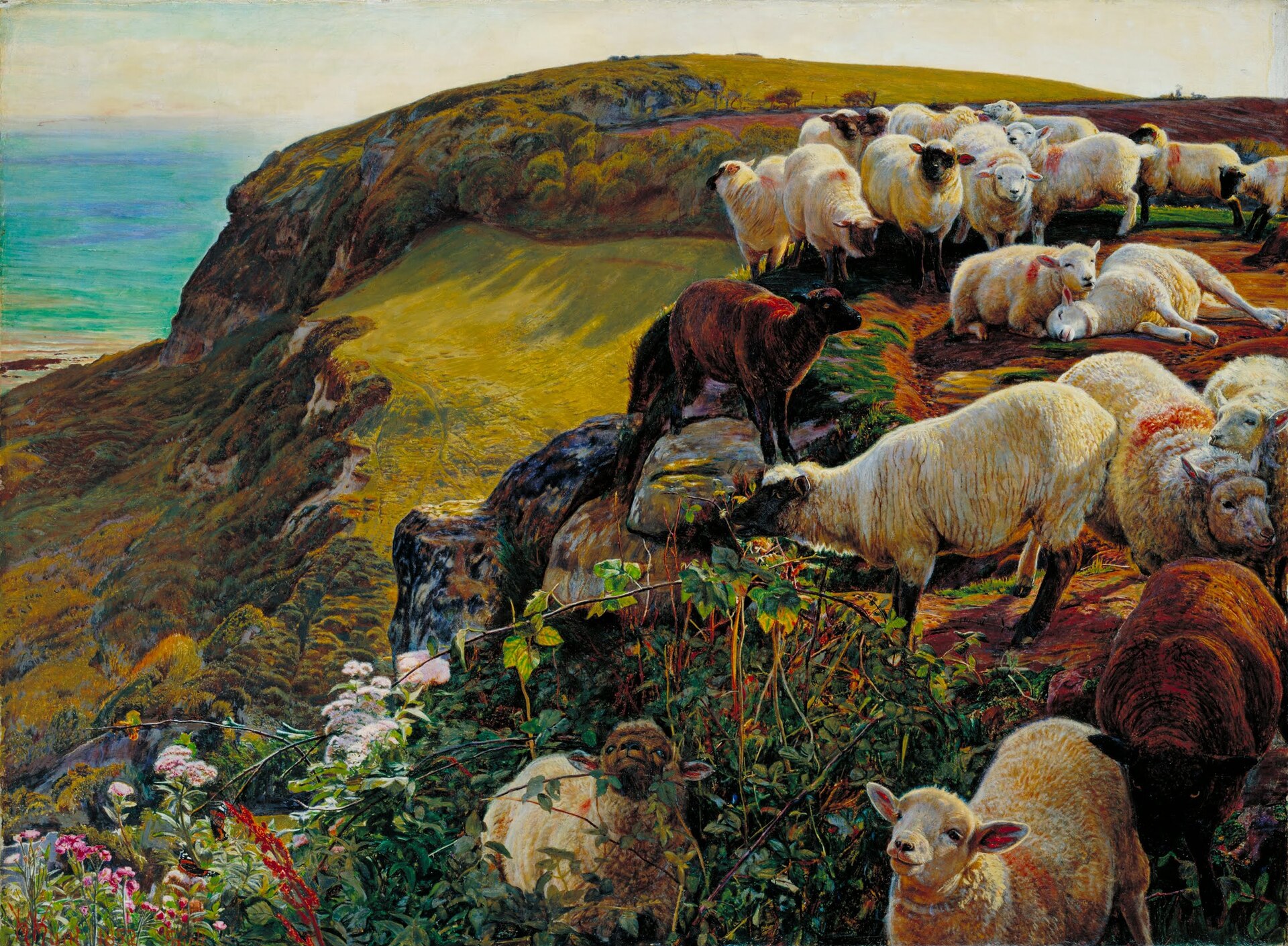
Historic and Modern British Art | Beauty and Protest 1845-1905 (Room 10) You are looking at a painting of sheep that wants to be taken seriously as a picture of England.
In 1852 Hunt went to the Lovers' Seat, a cliff viewpoint at Fairlight Glen near Hastings, and painted this landscape on the spot, from mid-August into December — rain, wind, bitter cold, the Channel weather changing from hour to hour. Look at the light on the turf and the animals' backs: cold, brilliant, almost metallic. Contemporary audiences, used to soft brown landscapes, were astonished by the colour, which Hunt set side by side in daring, intense notes.
The picture began as a commission from a friend, Charles Theobald Maud, who had asked for the little flock of sheep from the background of an earlier Hunt painting. What he got was something much bigger: an entire English coast, the sheep glowing against an edge of sea and cliff.
At the Royal Academy in 1853 it was shown as Our English Coasts. In Paris two years later, at the great international exhibition, it was renamed Strayed Sheep — and the French, who had just discovered their own landscape painting outdoors, understood it at once.
Tate acquired the painting in 1946, with help from the National Art Collections Fund.
Find the sheep that has strayed from the flock — alone, close to the edge. That, in a painting that is technically about wool, is the sermon.
William Holman Hunt, Our English Coasts, 1852 ('Strayed Sheep'), 1852. Image: William Holman Hunt via Wikimedia Commons (Public domain).
-
05Stop 5 of 12 · Historic and Modern British Art | Beauty and Protest 1845-1905 (Room 10)
The Awakening Conscience
Oil paint on canvas
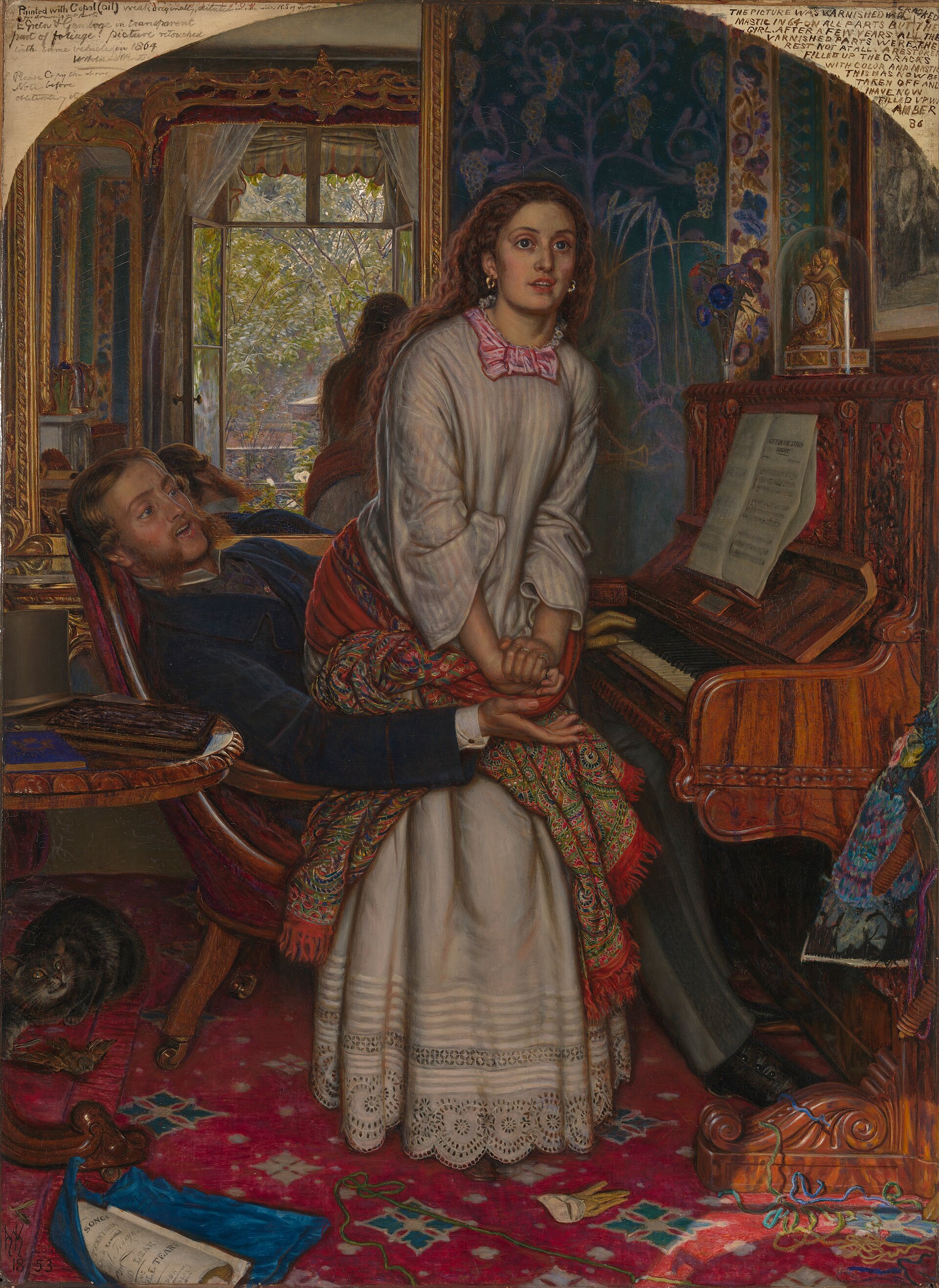
Historic and Modern British Art | Beauty and Protest 1845-1905 (Room 10) Now a Victorian interior with a story you have to decode. A wealthy man has settled his mistress in this apartment. He is playing the piano; a song is in the air. And something in that tune has woken the woman from the life she has been living. She rises from his lap, turning toward the light — and her reflection in the mirror shows you the world outside: green, bright, waiting.
The room is a trap dressed as luxury. On the floor, a cat has cornered a bird. The woman herself is echoed by the small figure sealed inside the glass dome — the shape of the dome repeating the shape of the picture. Hunt is telling you: this room is a glass case.
Annie Miller, who sat for so many of the Brotherhood and was briefly engaged to Hunt, modelled the woman. The painting shocked critics at the Royal Academy in 1854 — her expression of pain and horror felt too raw — and Hunt went back to it years later, in 1864 and again in 1886, softening the look. What you see today is a quieter picture than the first.
John Ruskin, the great champion of the group, praised it as a new kind of painting: not a scene from history or myth, but a whole story conjured from an artist's imagination — and one only a conversation with the painting can finish.
Look at the mirror. That is the exit she hasn't taken yet.
William Holman Hunt, The Awakening Conscience, 1853. Image: William Holman Hunt via Wikimedia Commons (Public domain).
-
06Stop 6 of 12 · Historic and Modern British Art | Beauty and Protest 1845-1905 (Room 10)
Beata Beatrix
Oil paint on canvas
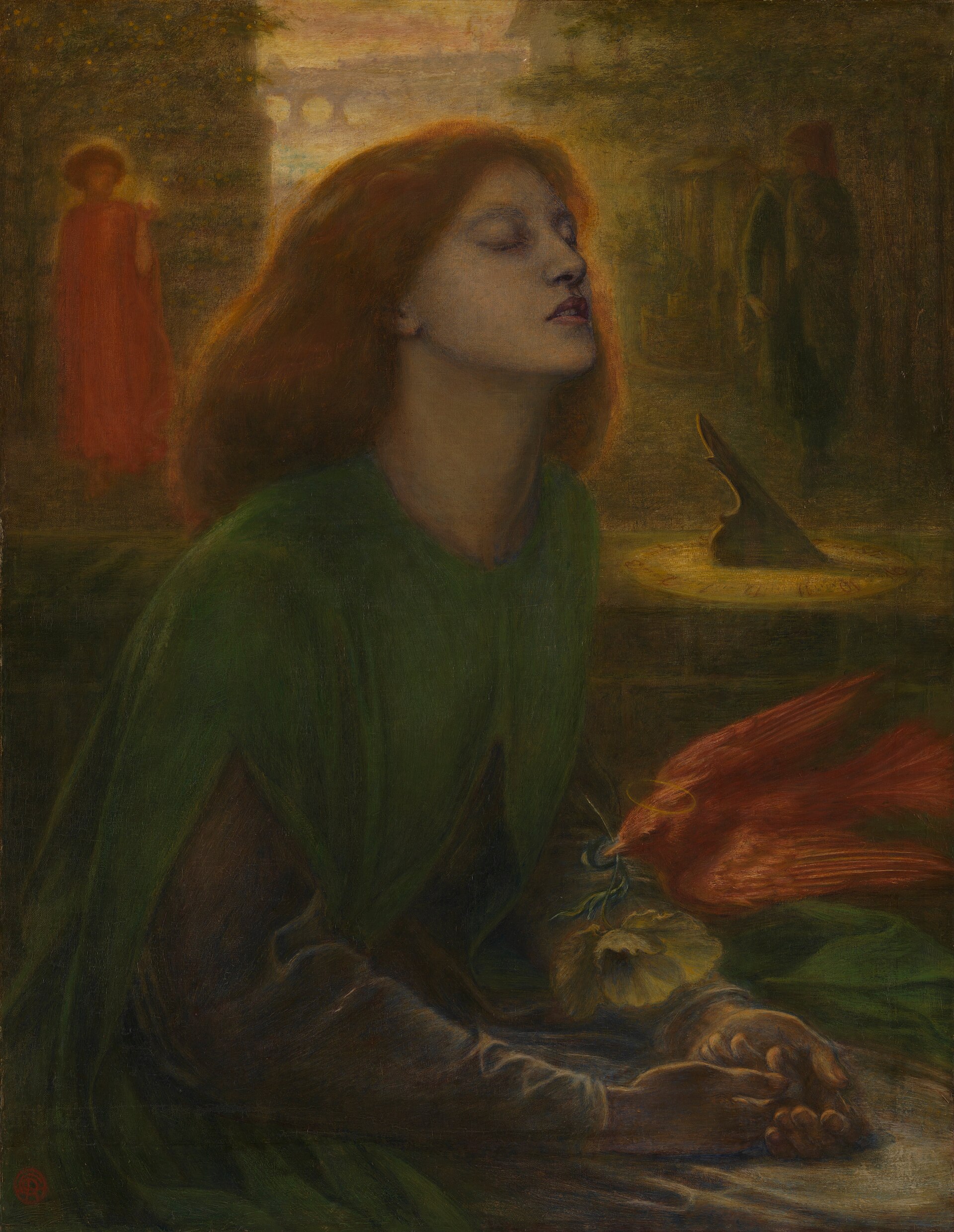
Historic and Modern British Art | Beauty and Protest 1845-1905 (Room 10) In February 1862, Elizabeth Siddal — the model who lay in the bath for Ophelia, and Rossetti's wife — died of an overdose of laudanum. She was thirty-two. For months Rossetti was inconsolable. Then he began this painting, and he worked at it, on and off, for the rest of the decade.
He imagines her as Beatrice, the beloved of the medieval poet Dante Alighieri — a comparison that had haunted him for years, because his own name, Dante Gabriel, was given to him by a father who saw destiny everywhere. Here Siddal sits in a dreamlike Florence, eyes closed, hands open, as if in trance. A bird, red as fire, drops a white poppy between her palms. The poppy is sleep, death — and also laudanum, the drug that killed her. Behind, Dante walks, and the figure of Love holds up a burning flame. A sundial marks the hour she slipped away.
Rossetti said he meant it, quote, "not as a representation of the incident of the death of Beatrice, but as an ideal of the subject, symbolized by a trance or a sudden spiritual transfiguration."
He painted her from the many drawings he had made while she was alive. It is a memorial, but it refuses to be a corpse. The light behind her is sunrise, not night.
Look at her face. It is the least sentimental portrait of grief in this room.
Dante Gabriel Rossetti, Beata Beatrix, c.1864–70. Image: Dante Gabriel Rossetti via Wikimedia Commons (Public domain).
-
07Stop 7 of 12 · Historic and Modern British Art | Beauty and Protest 1845-1905 (Room 10)
The Beloved ('The Bride')
Oil paint on canvas
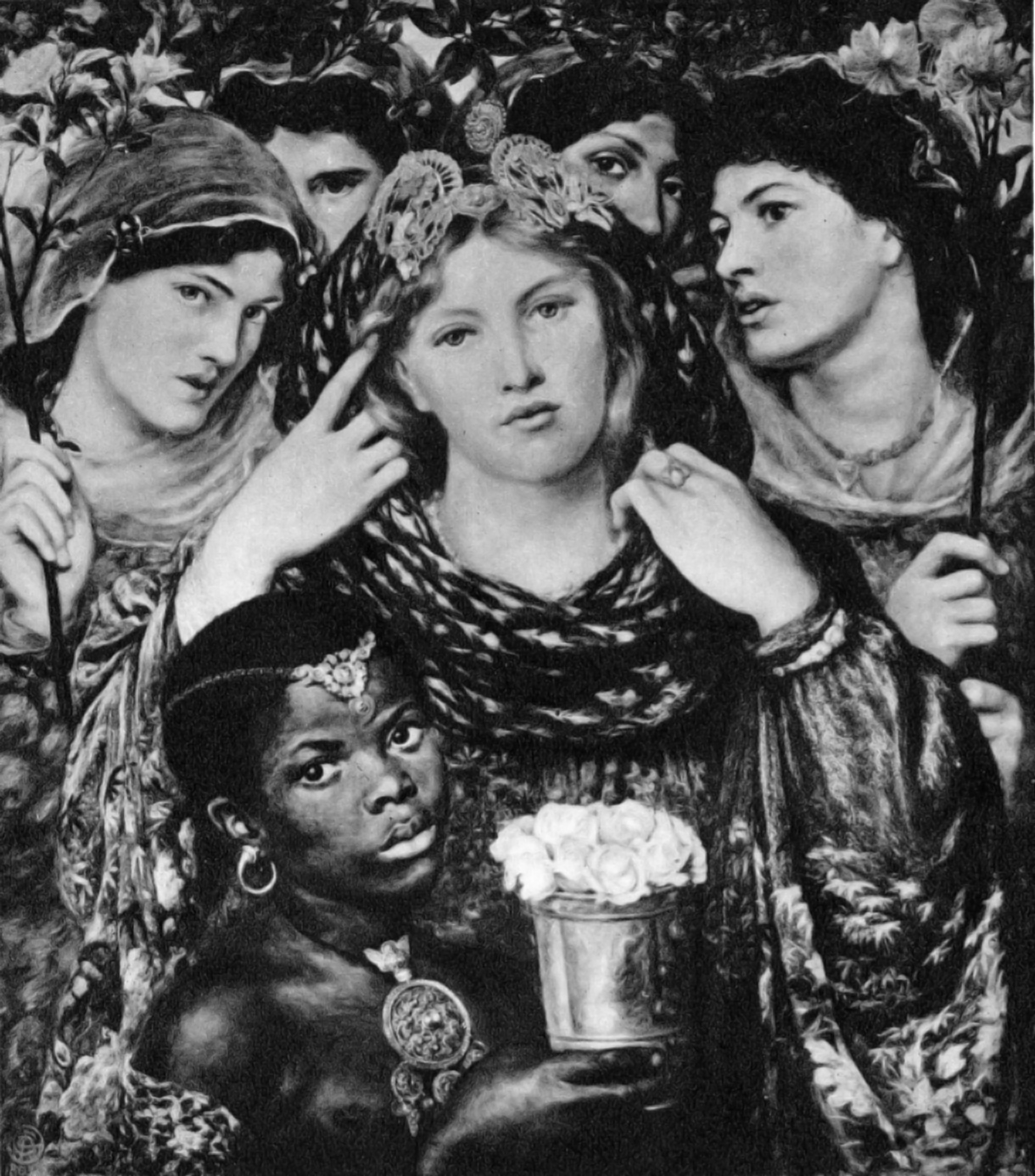
Historic and Modern British Art | Beauty and Protest 1845-1905 (Room 10) This is Rossetti at his most sumptuous — a wedding, or a crown, taken from the Song of Solomon: a bride unveiling herself before her beloved, surrounded by companions.
Stand close and count the faces. The women around the bride were modelled by Ellen Smith, an English laundress; by Fanny Eaton, who was of Jamaican heritage and a favourite model of the Pre-Raphaelite circle; and by Kiome Bonnet, of Romany descent. The boy in the foreground — his name is not recorded — had been brought to London from America around the time slavery was abolished there. At the centre, veiled in the white on which the whole design turns, is Mary Ford.
Rossetti was doing something rare in Victorian art: painting the city's real, mixed population and refusing the narrow pale ideal of beauty — even while keeping the white sitter at the centre of the composition. Tate's gallery label, written much later, names both facts: the challenge, and the hierarchy it didn't escape.
The picture was commissioned by Rossetti's loyal patron, the Birkenhead banker George Rae, for three hundred pounds. In February 1866 it was shown to the public for exactly one day, at the Arundel Club.
Look at the fabrics and jewellery — North African and East Asian pieces, part of the Victorian fantasy of the exotic. And then look at the boy's eyes, front and centre, looking straight back at you.
Dante Gabriel Rossetti, The Beloved ('The Bride'), 1865–6. Image: Dante Gabriel Rossetti via Wikimedia Commons (Public domain).
-
08Stop 8 of 12 · Historic and Modern British Art | Beauty and Protest 1845-1905 (Room 10)
Proserpine
Oil paint on canvas
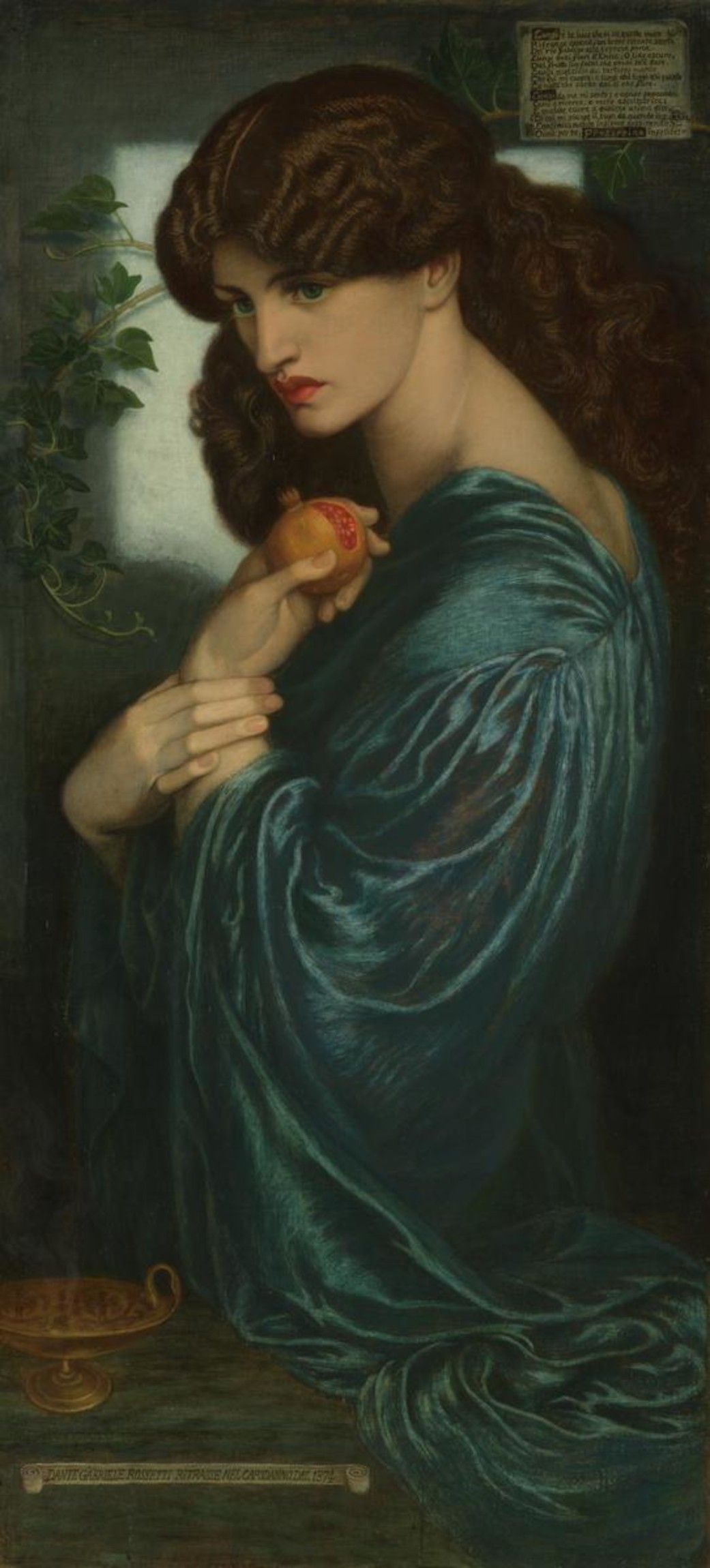
Historic and Modern British Art | Beauty and Protest 1845-1905 (Room 10) One myth, painted eight times. Proserpine, daughter of Ceres, was carried off to the underworld by Hades. Because she ate six pomegranate seeds while imprisoned below, she is bound to spend six months of every year in the dark — and the world above has winter. It is the oldest story we have of the seasons, and of a life divided against itself.
This is the moment just after she has bitten into the pomegranate. She stands against the dark, lit by a single beam of sunlight from the world she has lost. The model is Jane Morris, the woman Rossetti painted obsessively through the last decade of his life. And the subject — a woman imprisoned, longing for the light — was not, for him, only mythology.
Tate's canvas is one of at least eight versions. This one, made in 1874, was commissioned by the shipping magnate Frederick Richards Leyland. Rossetti wrote a sonnet to go with the picture, and the poem's longing may have been aimed at Jane herself. In the last year of his life, the year he died, he was working on an eighth Proserpine still.
That is the Pre-Raphaelite dream running its course: a single image, repeated, perfected, folded back on itself.
Look at the fruit in her hand, and the trapped square of light.
Dante Gabriel Rossetti, Proserpine, 1874. Image: Dante Gabriel Rossetti via Wikimedia Commons (Public domain).
-
09Stop 9 of 12 · Historic and Modern British Art | Art for the Crowd 1815-1905 (Room 8)
The North-West Passage
Oil paint on canvas
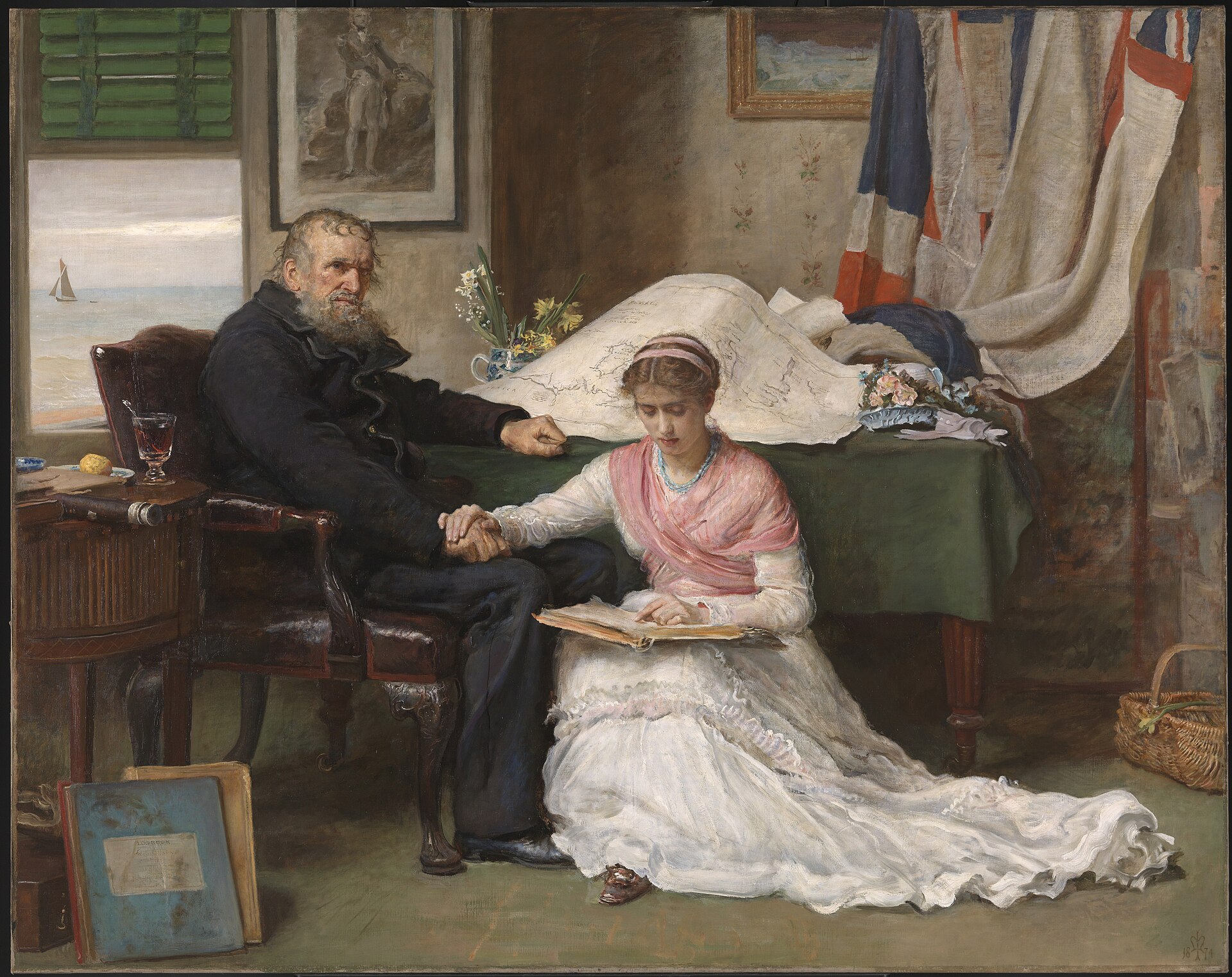
Historic and Modern British Art | Art for the Crowd 1815-1905 (Room 8) Now move to Room 8 — Art for the Crowd — for the last four paintings. Take your time; the route continues when you arrive.
An old sailor sits in an armchair, an 18th-century chair in an Arctic story, staring straight out at you. His daughter sits beside him, reading aloud from a log-book. On the desk is a chart of the North-West Passage — the sea route around North America through the Canadian Arctic, dotted with islands that, in 1874, were still only half mapped. On the wall hang a picture of a ship frozen in ice, and an etching of a young officer: perhaps the man in the chair, forty years earlier.
Millais painted this while Britain was preparing the Arctic expedition of 1875, led by George Nares. When he exhibited the picture he added a line of text, imagined as the old man's words: "It might be done and England should do it."
He is a man who knows what it costs. The North-West Passage meant failure, frostbite and death as much as glory, and his face carries all of it.
The model for the sailor was Edward John Trelawny, the adventurer who had been a friend of Byron and Shelley. He was persuaded to sit by Millais's wife, Effie — who agreed, in exchange, to attend and assist at a Turkish bath that Trelawny was promoting.
Look from the young officer's face on the wall to the old man in the chair. That's the whole story of empire in one room.
John Everett Millais, The North-West Passage, 1874. Image: John Everett Millais via Wikimedia Commons (Public domain).
-
10Stop 10 of 12 · Historic and Modern British Art | Art for the Crowd 1815-1905 (Room 8)
The Golden Stairs
Oil paint on canvas
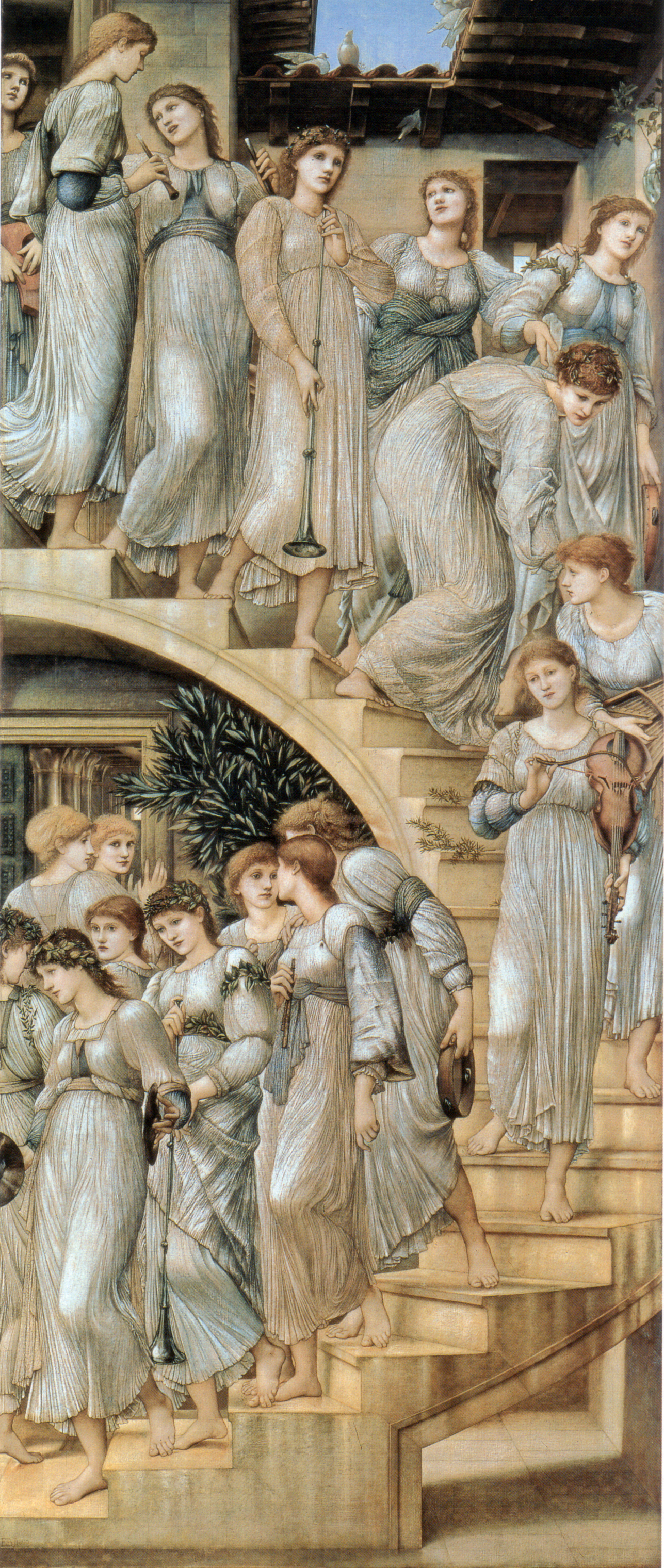
Historic and Modern British Art | Art for the Crowd 1815-1905 (Room 8) After the sermons and scandals, pure music — and a painting with no story at all. A line of young women descends a spiralling staircase, carrying instruments: cymbals, a violin, a horn. The palette runs from white through silver to gold. Nothing is happening. Everything is in motion.
Burne-Jones began this in 1876 and finished it in a rush in April 1880, days before it was to be shown at the Grosvenor Gallery. He had sketched such staircases after a trip to Italy in 1872 — the idea of a crowd of figures on a single flight of steps stayed with him for years.
The bodies were drawn from professional models, but the heads belong to young women of his own circle: Frances Graham, later Lady Horner, is at the bottom left, holding the cymbals; the stooping figure seven steps from the top is thought to be Edith Gellibrand.
This is Aestheticism — the movement that said a picture could be beautiful and nothing else. No moral, no text, no lesson. Just colour, rhythm, and a staircase that seems to lead somewhere between sleep and waking.
Walk along it as you would walk along the picture. Look at the feet — bare, stepping, almost weightless. Then look at the faces. Nobody is looking at us. They are inside the music.
Edward Burne-Jones, The Golden Stairs, 1880. Image: Edward Burne-Jones via Wikimedia Commons (Public domain).
-
11Stop 11 of 12 · Historic and Modern British Art | Art for the Crowd 1815-1905 (Room 8)
King Cophetua and the Beggar Maid
Oil paint on canvas
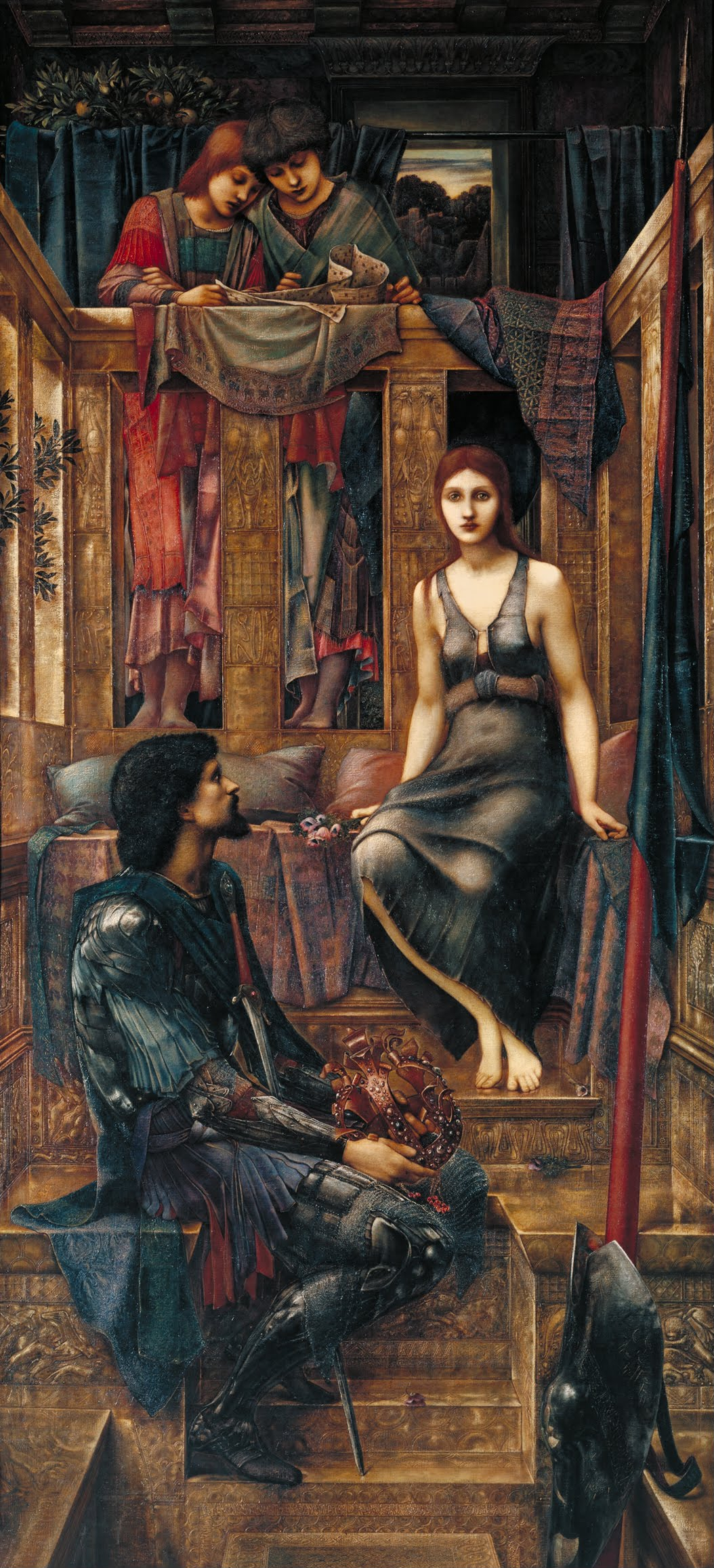
Historic and Modern British Art | Art for the Crowd 1815-1905 (Room 8) This is the legend of King Cophetua and the beggar maid, Penelophon — the king who falls in love with a woman so poor she has nothing at all, and raises her to his throne. Burne-Jones knew the tale from an Elizabethan ballad in an eighteenth-century collection, and from Tennyson's poem The Beggar Maid. He began the painting in 1881, worked through the winter of 1883 into 1884, and declared it finished that April.
It became his greatest success of the decade. The story is one of power overcome by beauty and simplicity — the king has laid his crown on the floor and his sword aside, and looks down at the girl in plain grey, who will not look up. On the wall behind them hangs a picture within the picture: a frieze of lovers, held prisoner — the legend on which everything else here comments.
The composition is deeply learned: Burne-Jones borrows the shape of a Mantegna altarpiece, the Madonna della Vittoria of 1496, turning a religious design into a fairy tale about love. It had taken him twenty years — he had tried the same story in an earlier painting of 1861, which is also in this collection.
Look at the distance between them on the dais: a king kneeling, a beggar standing still as stone. The whole painting lives in that gap.
Edward Burne-Jones, King Cophetua and the Beggar Maid, 1884. Image: Edward Burne-Jones via Wikimedia Commons (Public domain).
-
12Stop 12 of 12 · Historic and Modern British Art | Art for the Crowd 1815-1905 (Room 8)
The Lady of Shalott
Oil paint on canvas
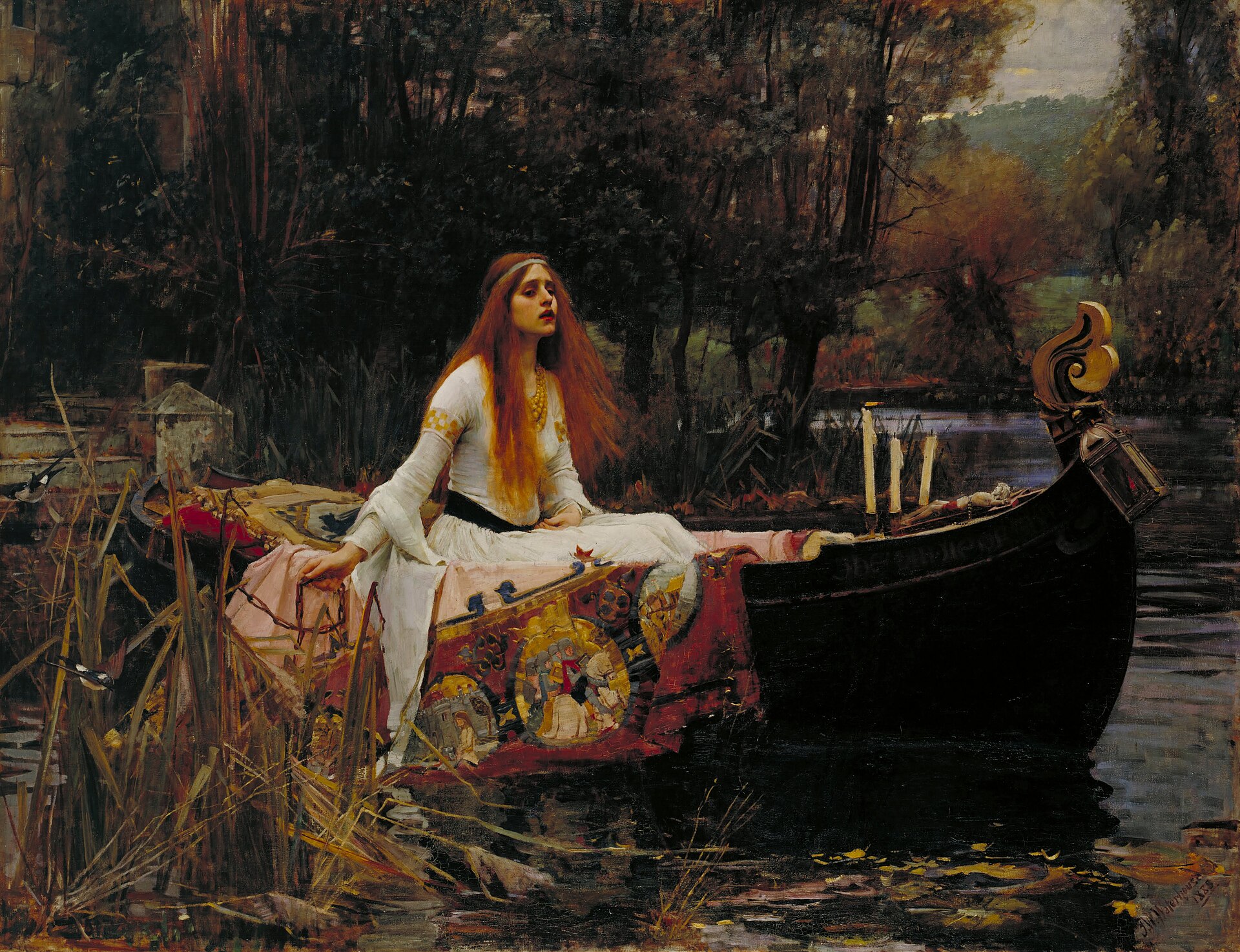
Historic and Modern British Art | Art for the Crowd 1815-1905 (Room 8) The last painting, and the end of the dream. Alfred, Lord Tennyson's poem The Lady of Shalott, published in 1832, tells of a woman under a curse in a tower on an island. She may not look directly at the world. Everything she knows comes to her through a mirror, and what she sees in the mirror she weaves into a tapestry. Then Sir Lancelot rides past, and she looks. The mirror cracks. She leaves the tower, finds a boat, and lies down in it, drifting towards Camelot — dead before she arrives.
Waterhouse painted this moment — the boat, the last ribbon loosed, the tapestry trailing over the edge in the water, the swallow, the ruined mirror. It is one of three versions he made of her across his life. This one, from 1888, was given to the public by Sir Henry Tate in 1894 — the man whose name is on the building.
Tennyson's poem is about a woman punished for wanting the real thing instead of its reflection. It is also, everyone who has ever loved a Victorian painting knows, about the imagination itself: the artist's dream, beautiful and sealed away, looking out at life through a mirror — until it can't resist, and looks.
Look at her face as she lets go: happy, he says, for the first and last time. That's the ending. Thank you — and take a moment before you move on; the room is worth a second lap.
John William Waterhouse, The Lady of Shalott, 1888. Image: John William Waterhouse via Wikimedia Commons (Public domain).
More routes
-
0112 stops · about 100 min
A Walk Through British Art: 1545–1914
One walk, twelve paintings: from the oldest work in Tate's collection to the eve of the First World War.
-
0211 stops · about 90 min
Turner: Light, Sea, Storm
Fifty years of Turner — from a moonlit debut to canvases left unfinished: sea, storm and light.
Stay in the loop
Want to know when a new museum or route is covered? Leave your email and we'll write when the next guide is ready — nothing else, ever.
No spam. Unsubscribe any time.