Tate Britain · 11 stops · about 90 min
Turner: Light, Sea, Storm
Fifty years of Turner — from a moonlit debut to canvases left unfinished: sea, storm and light.
The Clore Gallery in about ninety minutes · displays checked 2026-10-03
-
01Stop 1 of 11 · JMW Turner: Rise to Fame, Room 31
Fishermen at Sea
Oil paint on canvas
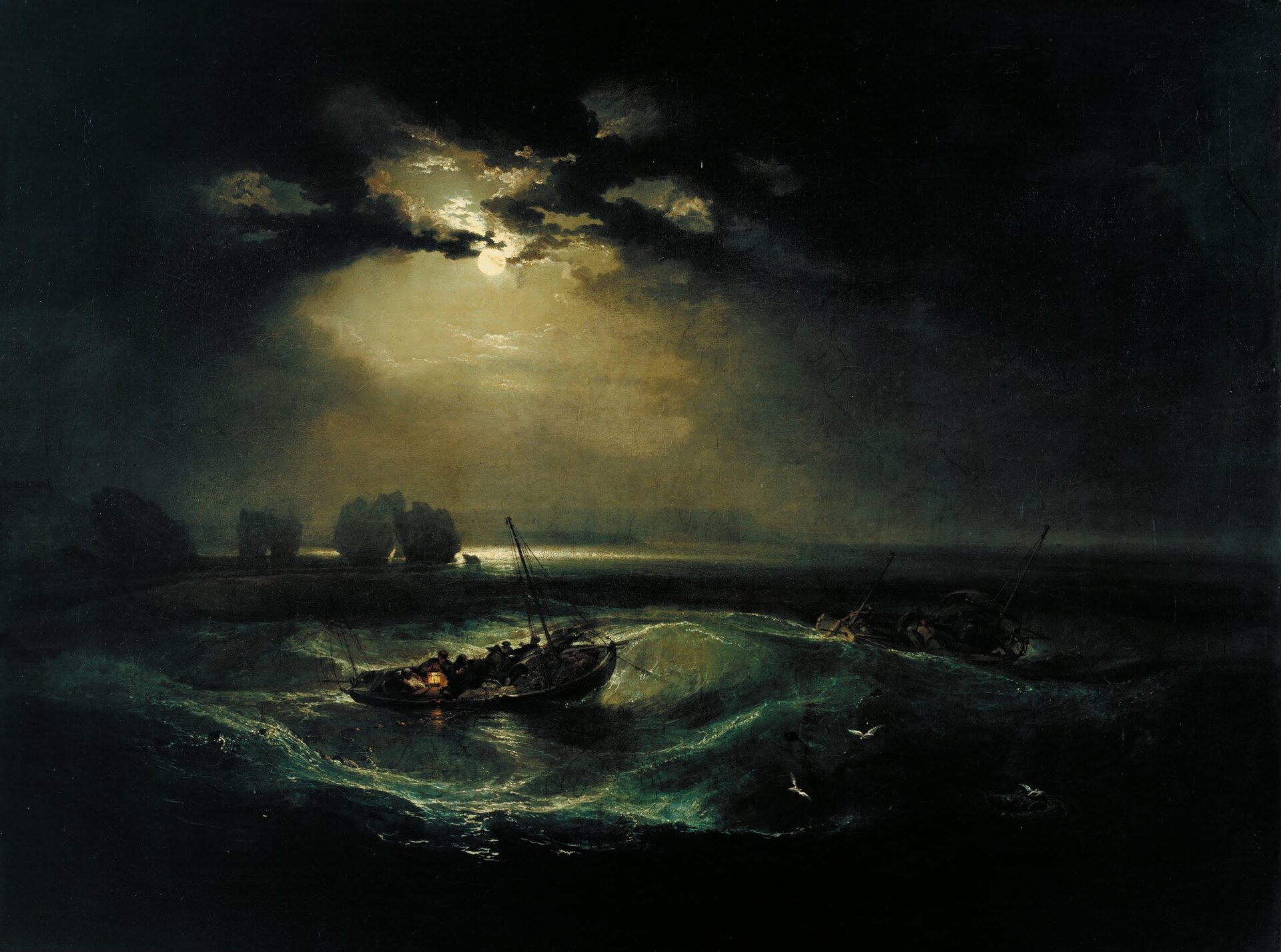
JMW Turner: Rise to Fame, Room 31 A small boat, a rough sea, a single lantern. Two fishermen are working their lines while around them the moonlight carves up the water and the clouds press down. There is no shore, no safety, nothing but the weather and the work.
This is Fishermen at Sea, the painting that introduced Turner to London. He was twenty-one when he exhibited it at the Royal Academy in 1796, and for a long time it was believed to be the first oil painting he ever showed there. Contemporary critics praised it, and it built his name as a painter of the sea.
Here's what makes it remarkable. The Royal Academy did not teach oil painting — Turner had to learn the technique himself, in years of private work. In this picture he is openly showing off his knowledge of Rembrandt, building the whole scene from darkness up into light: the cold blue of the moon, the warm flicker of the boat lamp, the soft grey of the water between them.
The painting has belonged to Tate since 1972, and is sometimes called the Cholmeley Sea Piece after an early owner. But titles don't matter here. What matters is that a boy from Covent Garden has taken an ordinary night at sea, and made it feel like the beginning of the world.
Look for the lantern. It's tiny, and it's the only warm thing in the picture — the whole huge drama balances on that one little human light.
J.M.W. Turner, Fishermen at Sea, 1796. Image: J. M. W. Turner via Wikimedia Commons (Public domain).
-
02Stop 2 of 11 · JMW Turner: Rise to Fame, Room 31
Self-Portrait
Oil paint on canvas
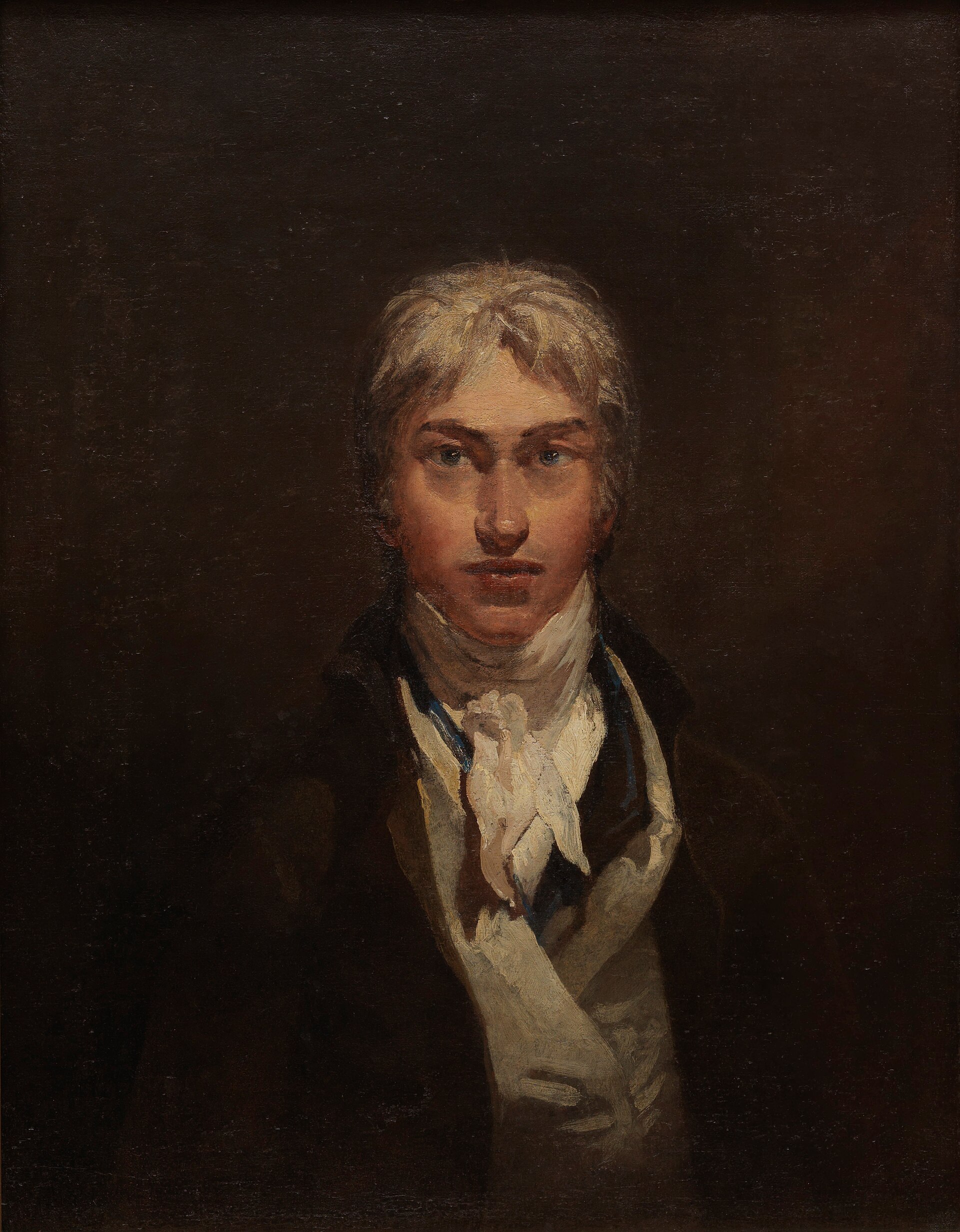
JMW Turner: Rise to Fame, Room 31 A young man stares back at us: dark coat, collar turned up, two waistcoats, white neckcloth — no uniform, no props, no grand background. Just a person looking at you.
Turner painted this around 1798 or 1799, when he was about twenty-four. In November 1799 he was elected an Associate of the Royal Academy — one of the youngest artists ever to reach that position, which meant he could show at the Academy's exhibitions without fear of rejection. The portrait may have been made to mark exactly that moment: the self-made man, arriving.
It became familiar to millions: from 2020 the Bank of England used this face on the twenty-pound note.
One live controversy. In 2026 the writer James Hamilton argued that the painting is probably not a self-portrait at all, but the work of the portrait specialist John Opie — because in early lists it's described only as a portrait of Turner, not by him. The gallery still labels it as Turner. I'll leave the verdict to you and the art historians, and simply note that even the authorship of Turner's face is, in the end, a Turner problem: contested, argued over, famous.
Look at the collar, turned up against the world — the original artist-as-romantic, painted before the romance existed. And notice how the pose hides the prominent nose everyone who knew him described. Whoever held the brush, someone was being careful.
J.M.W. Turner, Self-Portrait, c.1799. Image: J. M. W. Turner via Wikimedia Commons (Public domain).
-
03Stop 3 of 11 · JMW Turner: Rise to Fame, Room 31
Snow Storm: Hannibal and his Army Crossing the Alps
Oil paint on canvas
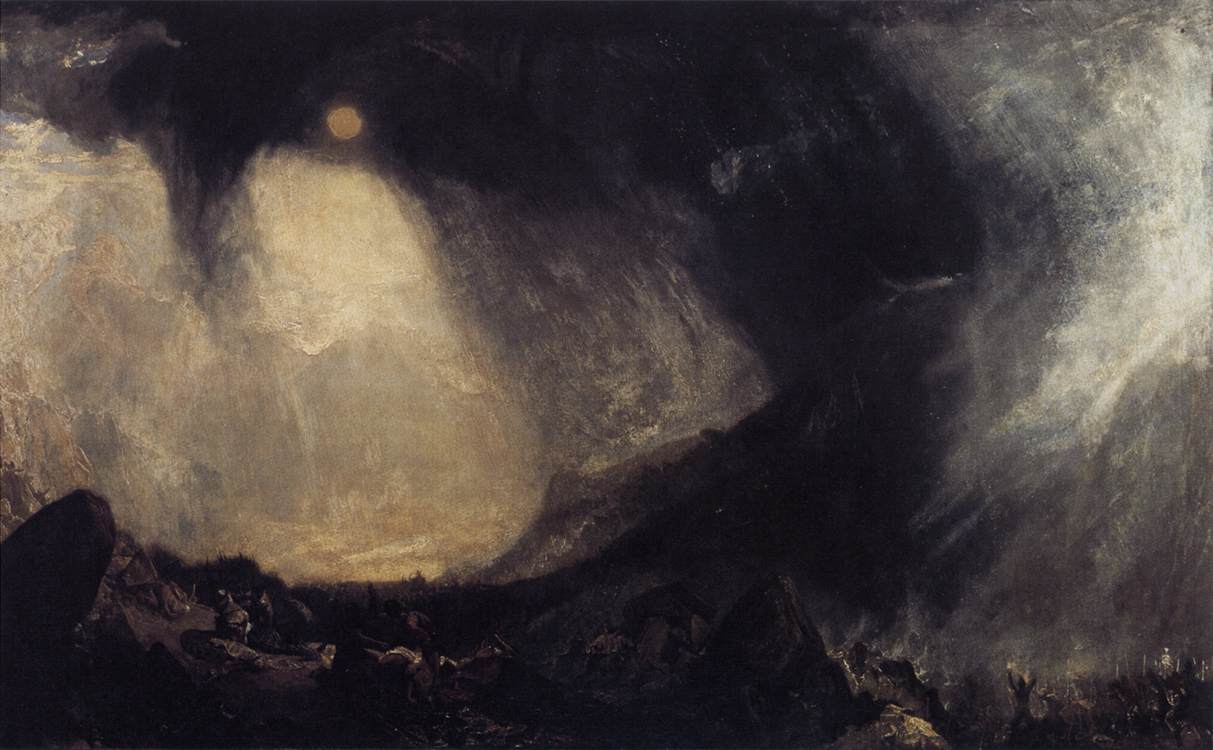
JMW Turner: Rise to Fame, Room 31 Snow, mountains, and an army being swallowed whole. In the bottom corner, barely visible through the blizzard, Hannibal rides an elephant while his soldiers disappear into the storm.
This is Hannibal crossing the Alps in 218 BC — the general who marched his army into Italy and nearly broke Rome. Turner painted it in 1812, while Britain was at war with Napoleon, and everyone in the know read the parallel: another charismatic leader whose ambition was battering against winter and fate.
Two things to notice. First, the composition. The painting spins — a great vortex of snow, cloud and mountain with the human beings swept around its edge. Classical landscapes arranged things on calm horizontal lines. Turner replaces that with a whirlpool, and he does it to unlock what the eighteenth century called the sublime: the pleasure, and the terror, of being small in front of nature.
Second, the hanging. When he showed it at the Royal Academy, Turner hung this large painting low, at eye level, when grand pictures were supposed to go near the ceiling. He wanted you to be inside the storm, not looking up at it.
It came to the nation as part of the Turner Bequest in 1856, and it still does exactly what he intended: you stand in front of it, and the weather takes over.
Let your eye follow the swirl once, all the way round. That's how the painting is built. Nothing in it stands still.
J.M.W. Turner, Snow Storm: Hannibal and his Army Crossing the Alps, 1812. Image: J. M. W. Turner via Wikimedia Commons (Public domain).
-
04Stop 4 of 11 · Turner and his Critics, Room 32
Peace – Burial at Sea
Oil paint on canvas
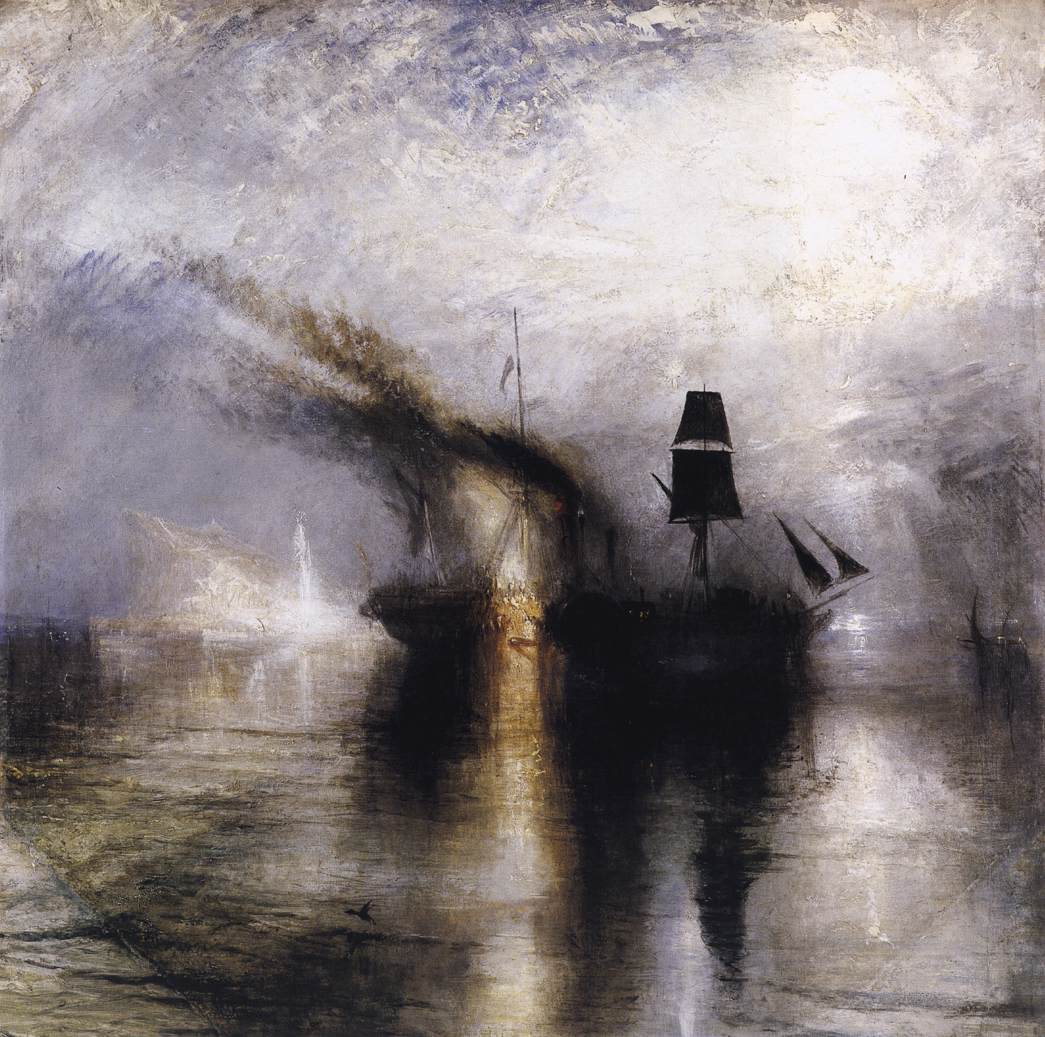
Turner and his Critics, Room 32 Now move next door into the room called Turner and his Critics. This painting stopped the room.
In 1841 Turner's friend, the Scottish painter Sir David Wilkie, died of typhoid on his way home from the Middle East. Fearing the disease, the Governor of Gibraltar refused to let the body come ashore, and Wilkie was buried at sea. Turner's memorial invents the funeral he should have had: a black funeral carriage on the deck of a ship, sails dark as mourning, and the white cliffs of England rising in the distance.
Fearless of convention even in grief, Turner shaped the canvas into an octagon — look for the cut corners — as he experimented with square and octagonal formats in the 1840s. He painted it as the companion to War, his picture of Napoleon dying in exile, so the pair argues about how a great life ends: buried with honour at sea, or fading on a rock in the middle of the ocean.
Critics complained that the sails were too black. Turner replied that he only wished he could have made them blacker.
That's the man in one sentence — he would rather be attacked for going too far than praised for going halfway. This room is full of that same argument: reviews, mockery, praise, and Turner, painting exactly as he liked.
Look at the ship, then at those cliffs. Home is close enough to see, and too far to reach.
J.M.W. Turner, Peace – Burial at Sea, 1842. Image: J. M. W. Turner via Wikimedia Commons (Public domain).
-
05Stop 5 of 11 · Experiments on Canvas, Room 34
Sunrise with Sea Monsters
Oil paint on canvas
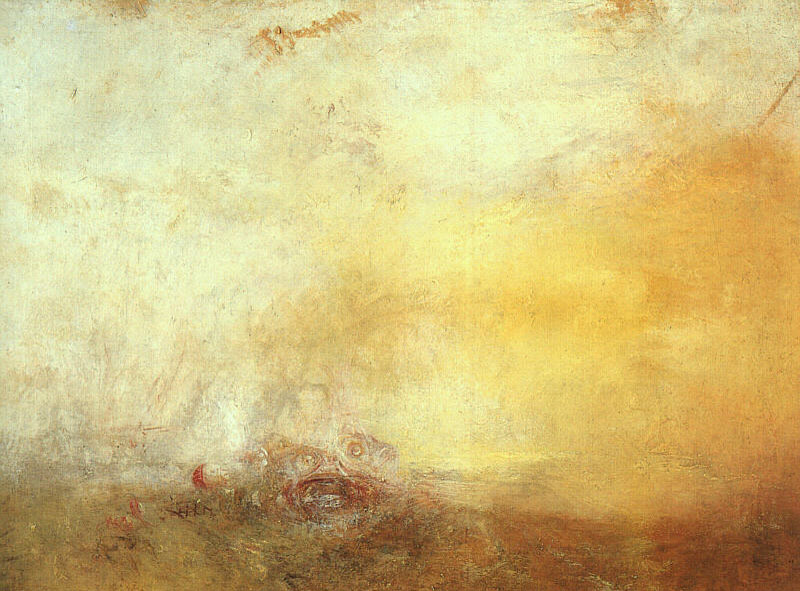
Experiments on Canvas, Room 34 Welcome to Experiments on Canvas — the late room, where the future arrives.
A yellow sunrise burns through mist over a grey sea. And in the corner, in pink and red, something is moving: the shapes that gave this painting its name — Sea Monsters.
Turner made it around 1845, in Margate, near the end of his life, and left it unfinished. Look closely at those creatures. Tate's own view is that they are simply fish; there are a few black cross-hatches nearby that may be part of a fishing net. One critic has suggested the mist might even hide a steam paddleboat, being swallowed by giant fish — a theme, as you'll see nearby, that obsessed late Turner.
The truth is nobody knows, and that's what makes it modern. Turner had spent fifty years painting ships and storms to be recognised; by the end, he was dissolving them into colour. This picture was never shown in his lifetime — it went on public display for the first time only in 1906, more than half a century after his death.
Stand back and squint, and the painting turns into pure weather: a shout of light with something alive under the surface. Then step closer, and watch the paint itself — loose, fast, improvised. This is the Turner who made twentieth-century painting possible.
J.M.W. Turner, Sunrise with Sea Monsters, c.1845. Image: J. M. W. Turner via Wikimedia Commons (Public domain).
-
06Stop 6 of 11 · Experiments on Canvas, Room 34
Sunrise, a Castle on a Bay: 'Solitude'
Oil paint on canvas
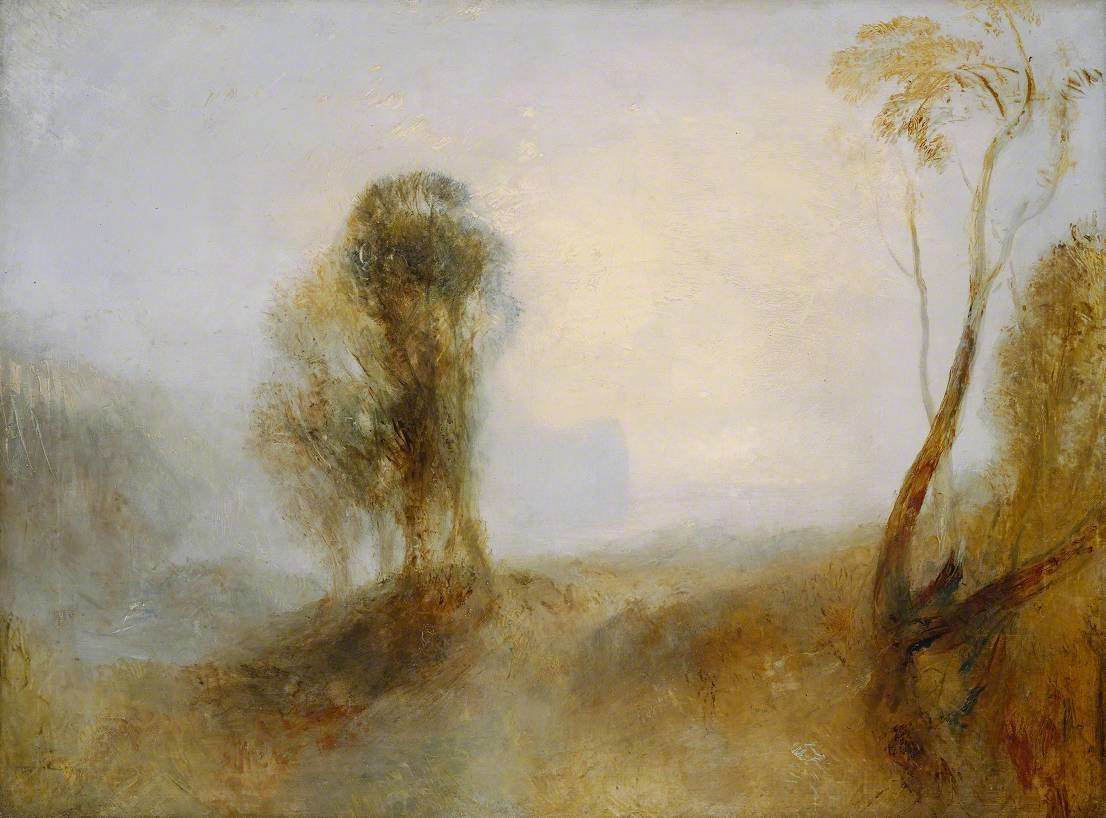
Experiments on Canvas, Room 34 This one is quieter. A castle on a bay, hills dissolving into haze, a wide sky taking up most of the picture — and a mood of complete stillness. Its title is Solitude.
It's unfinished — again, deliberately so, as far as anything was deliberate with late Turner. And it reaches backwards: the composition repeats one of his Liber Studiorum designs, the Book of Studies — his series of landscape prints, in which he sorted his landscapes into categories. This one belongs to his favourite: E.P. — Elevated or Epic Pastoral: the high, dreamed landscape.
Which means it's also a conversation with the past. The great master of that kind of landscape was the French painter Claude Lorrain, who painted the Roman countryside two centuries earlier, and this composition pays homage to him — to a painting by Claude now in the National Gallery in London.
So here is the shape of a whole career in one unfinished canvas: the young Turner copying the old masters, the middle-aged Turner competing with them, and the old Turner returning to their calm — but with the colour turned up, the edges going soft, the castle already half-melted into light.
Look at the horizon. You can't quite find where the land ends and the sky begins — and that, right there, is the future of landscape painting.
J.M.W. Turner, Sunrise, a Castle on a Bay: 'Solitude', c.1840–5. Image: J. M. W. Turner via Wikimedia Commons (Public domain).
-
07Stop 7 of 11 · Toil and Terror at Sea, Room 35
Snow Storm – Steam-Boat off a Harbour's Mouth
Oil paint on canvas
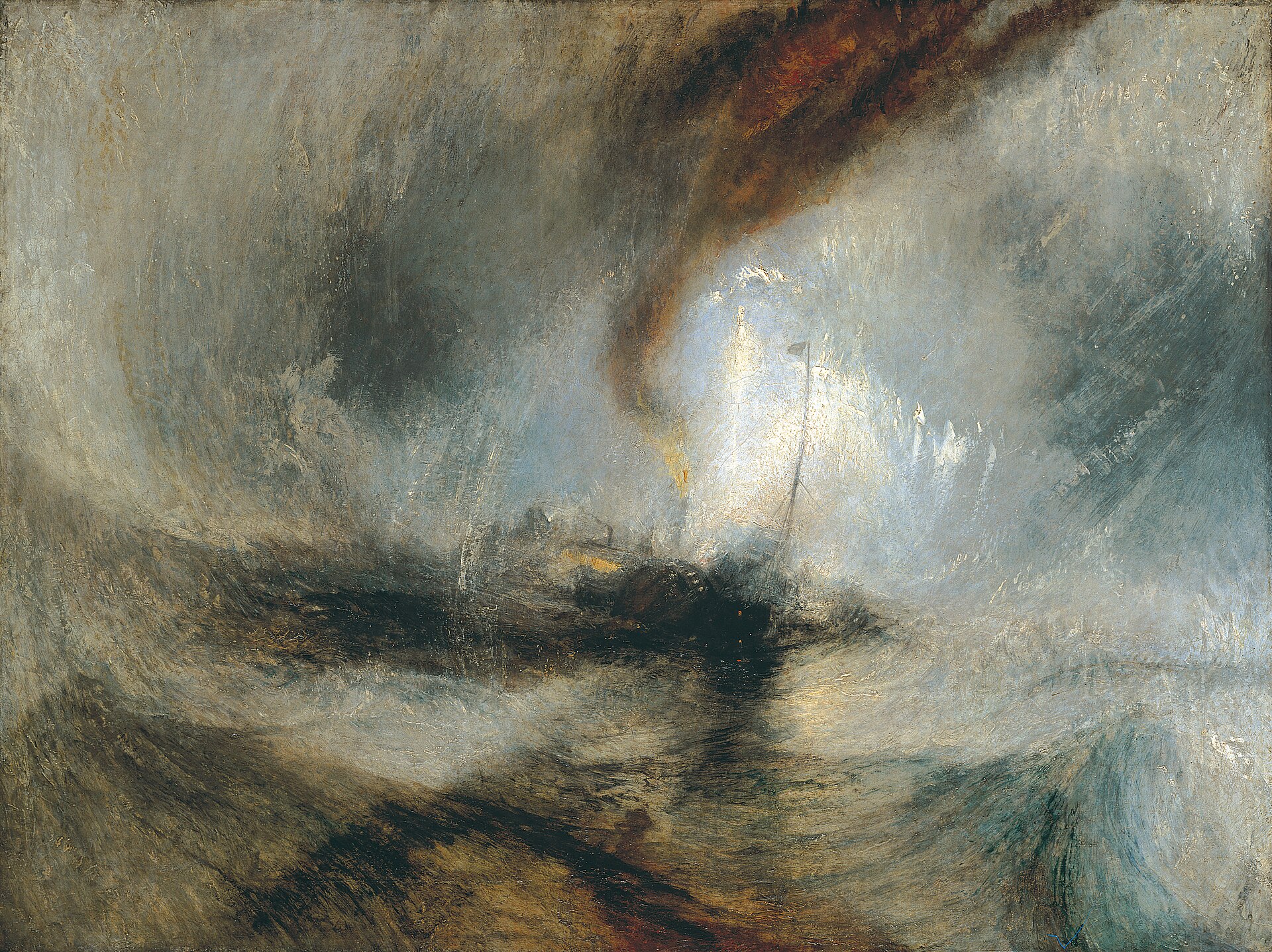
Toil and Terror at Sea, Room 35 Now step through to Toil and Terror at Sea — and hold on.
A steamboat is caught in a blizzard, its black funnel-smoke whipped into the same vortex as the snow. The sea, the sky and the ship are all one spinning mass. You are inside the storm, at night, with nothing stable to hold on to.
Turner claimed that he had himself lashed to the mast of a ship for four hours to watch a storm like this — the story is repeated by the gallery, but it can't be proven, and some historians doubt it ever happened. He did put a note on the painting saying he was aboard the Ariel when she left Harwich.
When this was shown in 1842, critics jeered that it looked like soapsuds and whitewash. Turner's answer is famous: "I did not paint it to be understood, but I wanted to show what such a scene was like."
John Ruskin called it one of the very grandest statements of sea-motion, mist and light ever put on canvas. Today it's ranked among Turner's masterpieces.
Look at the vortex — the spiral that runs through the middle of the picture like water going down a drain. Turner used that shape over and over, from Hannibal to this. It's his signature: the universe as a spinning storm, with human beings holding on at the edge.
J.M.W. Turner, Snow Storm – Steam-Boat off a Harbour's Mouth, 1842. Image: J. M. W. Turner via Wikimedia Commons (Public domain).
-
08Stop 8 of 11 · Toil and Terror at Sea, Room 35
A Disaster at Sea
Oil paint on canvas
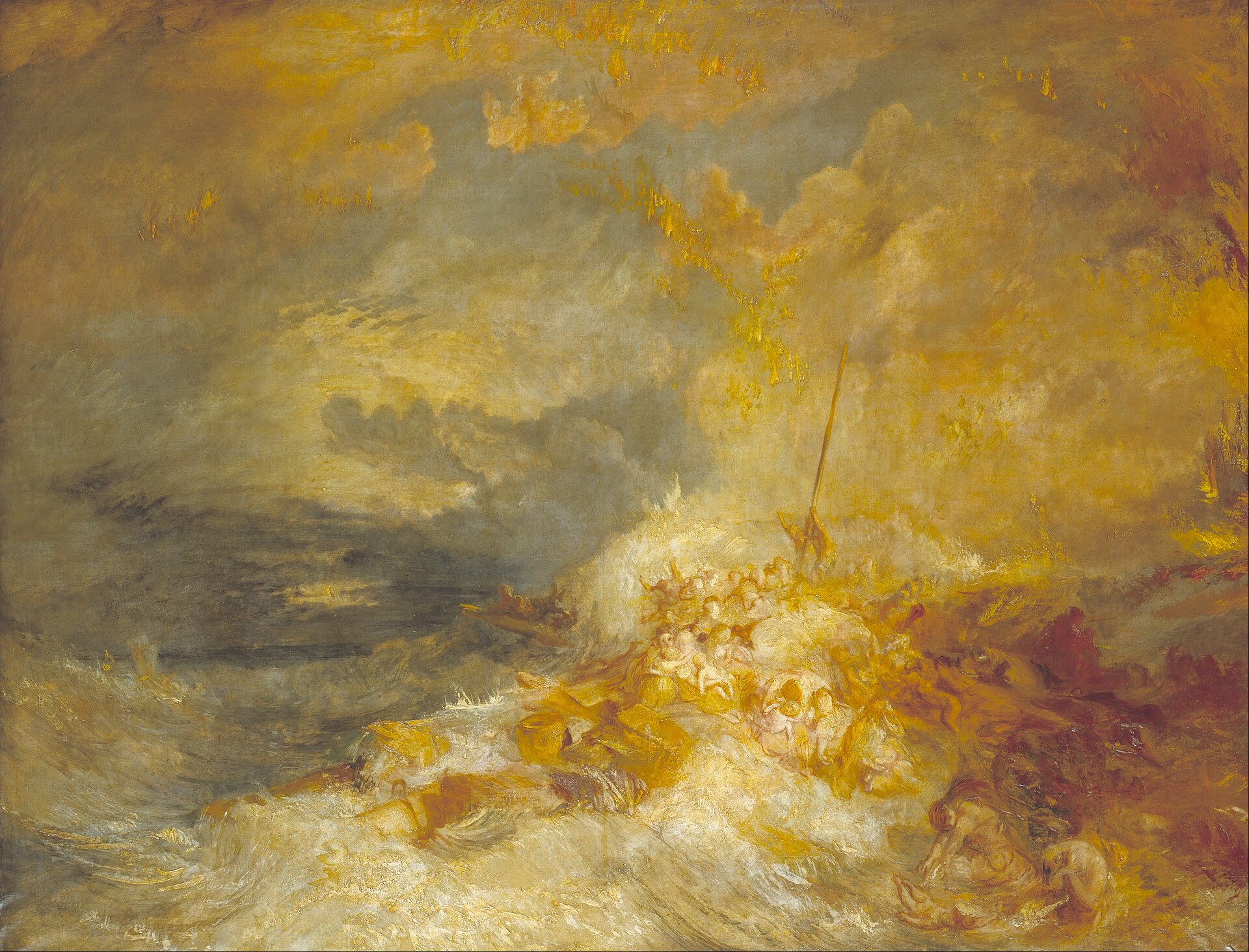
Toil and Terror at Sea, Room 35 Unfinished, unsigned, never exhibited in Turner's lifetime. And one of the saddest paintings he left behind.
A ship is going down. Figures cling to the wreck and to each other as the sea takes the vessel apart. There is no rescue in sight.
It probably shows the Amphitrite, which left London for New South Wales in 1833 carrying a hundred and eight women convicted of crimes, and twelve of their children. When the ship ran into difficulty near Boulogne, the captain refused offers of rescue — and when the ship broke up, only three people aboard survived.
In 2022 another candidate was proposed: the Hibernia, which burned in the South Atlantic in 1832 with two hundred and nine emigrants aboard and not enough lifeboats for all of them. Turner, who read the newspapers the way we scroll through them, painted both disasters into one canvas of ordinary people without a way out.
The composition leans on Géricault's Raft of the Medusa, the enormous French painting of shipwreck and desperation that Turner had seen in London in the early 1820s.
Look at the cluster of bodies in the water. Turner keeps them small, and that's the point: in the scale of the sea, a hundred lives are a detail — unless an artist refuses to let them be one.
J.M.W. Turner, A Disaster at Sea, c.1835. Image: J. M. W. Turner via Wikimedia Commons (Public domain).
-
09Stop 9 of 11 · Toil and Terror at Sea, Room 35
Seascape with Storm Coming On
Oil paint on canvas
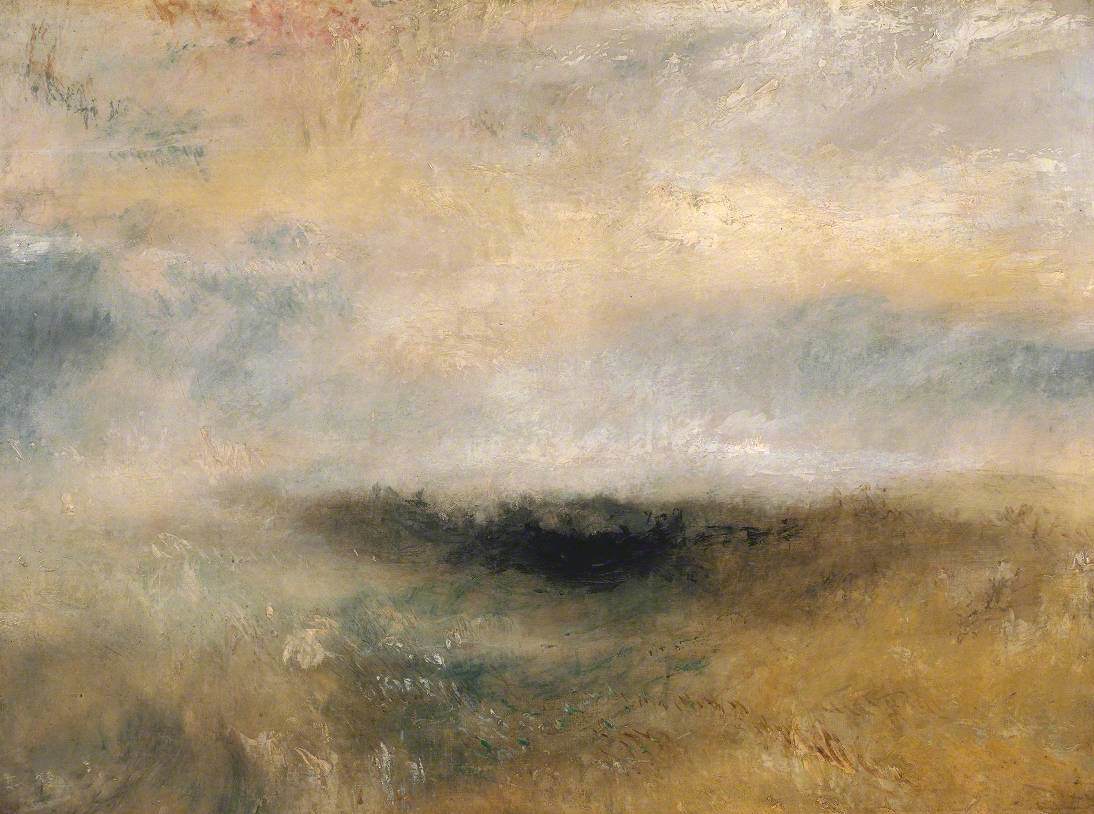
Toil and Terror at Sea, Room 35 Another unfinished seascape — and almost abstract. Warm reds and yellows in the sky, deep, layered greys on the water, a storm cloud building on the left. And at the centre, a strange grey-black mass.
The gallery can't identify it. It might be a wreck, it might be a whale, it might be the first thought of something else entirely. Turner may have been thinking of shipwrecks, or of the whales that appear in other paintings hanging in this room.
What is certain is the technique: the tones are built up in layer after layer of paint, warm passing into cold, until the surface seems to move. This is Turner paint-handling as weather — when you stand in front of it, you're not reading a scene, you're watching an atmosphere.
Most of these late, unfinished pictures were left in his studio. He kept them, worked on them, returned to them, refused to let them go. In a way, this room is the insides of his workbench: the experiments he made for himself, with nobody watching.
Look at the grey mass again, and let it stay unidentified. That uncertainty — that a master of the sea could paint something on the water and leave it unnamed — is exactly why painters after him loved him.
J.M.W. Turner, Seascape with Storm Coming On, c.1840. Image: J. M. W. Turner via Wikimedia Commons (Public domain).
-
10Stop 10 of 11 · Toil and Terror at Sea, Room 35
Yacht Approaching the Coast
Oil paint on canvas
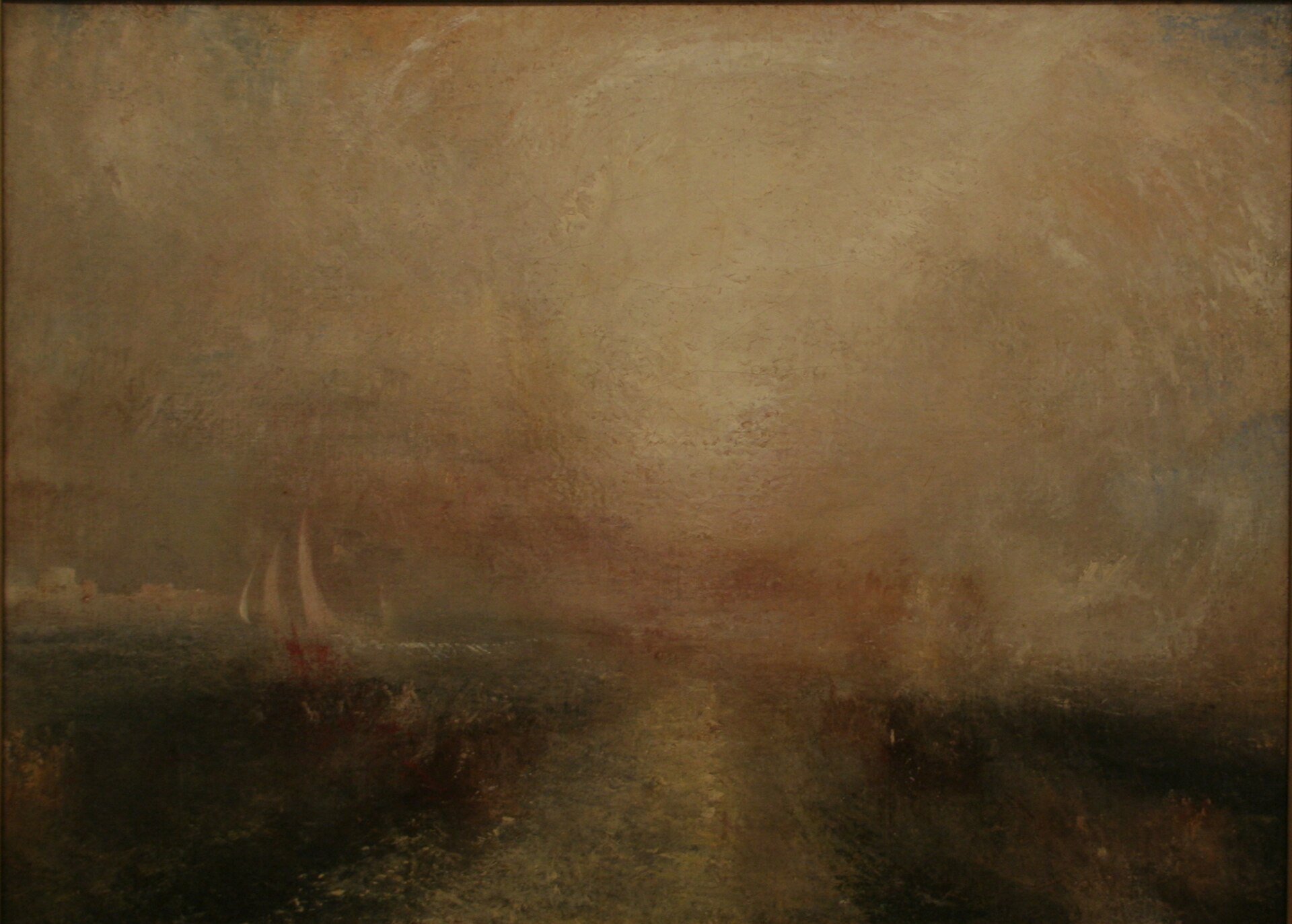
Toil and Terror at Sea, Room 35 One more unfinished canvas, and the gentlest of the storms.
A yacht approaches a coast, except that the yacht is almost gone. The light of the sun, doubled and multiplied in the water, dazzles your eyes; the picture seems to be mostly glare and haze. If you look hard, dark shapes might be boats; the buildings on the left might be Venice.
Turner worked on this canvas over several years, and each time he reworked it, he buried the original subject deeper. What started as a scene about a yacht became a painting about light itself — light as something that doesn't sit in the scene, but attacks it.
That is late Turner in one sentence, and it's why the French Impressionists, twenty years later, would track him down as an ancestor. He didn't need objects to make a picture. He needed the weather of seeing.
Take a step back and let the glare hit you, the way it would on a real coast. Then step forward and look at the paint — thin here, thick there, scraped, glazed, reworked.
And if you can still find the yacht, you're looking harder than Turner was. He had already left.
J.M.W. Turner, Yacht Approaching the Coast, c.1840–5. Image: J. M. W. Turner via Wikimedia Commons (Public domain).
-
11Stop 11 of 11 · Sea Power, Room 36
The Shipwreck
Oil paint on canvas
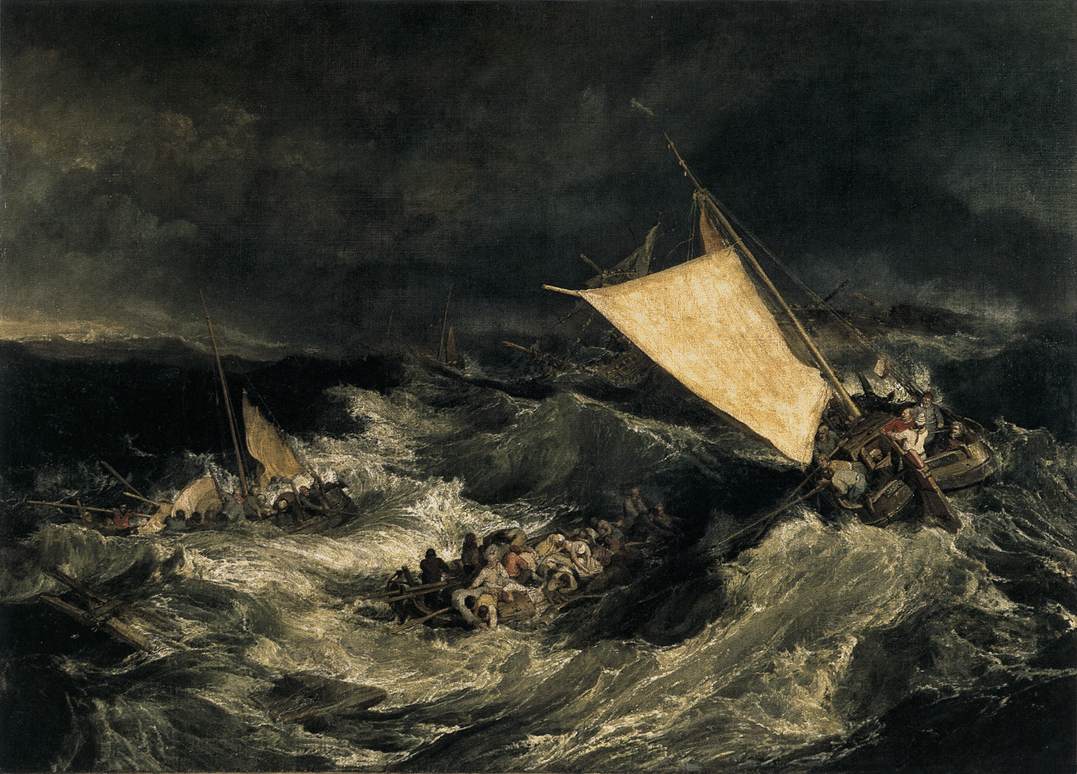
Sea Power, Room 36 The last room — Sea Power — and one of the paintings that made Turner's name: The Shipwreck, exhibited in 1805.
Fishermen battle towering waves to reach an overcrowded lifeboat while, behind them, a ship lies capsized and broken. There is no land in sight. Turner puts you out on the water with them, close to the wreck, close to the cold — you are not observing the disaster, you are in it.
He may have been inspired by an illustrated edition of William Falconer's poem The Shipwreck, published in 1804. And the painting probably records a real disaster: the Earl of Abergavenny, an East Indiaman that foundered off Weymouth in February 1805, with heavy loss of life.
Notice too how he showed it. Turner did not give this picture to the Royal Academy. He put it in his own gallery in Queen Anne Street — the painter as his own promoter, his own dealer, his own publicist, a very modern idea.
From this wreck, everything else in the route unfolds: the storms, the sunk ships, the demolished hopes, painted over and over for the next forty years. He never stopped trying to paint the moment when the sea wins.
Stand in front of the waves and find the boat. It's small — and it's all of us.
J.M.W. Turner, The Shipwreck, 1805. Image: J. M. W. Turner via Wikimedia Commons (Public domain).
More routes
-
0112 stops · about 100 min
A Walk Through British Art: 1545–1914
One walk, twelve paintings: from the oldest work in Tate's collection to the eve of the First World War.
-
0212 stops · about 90 min
Pre-Raphaelites: Truth & Beauty
The Brotherhood that painted every leaf and refused to flatter: love, conscience and legend in Victorian Britain.
Stay in the loop
Want to know when a new museum or route is covered? Leave your email and we'll write when the next guide is ready — nothing else, ever.
No spam. Unsubscribe any time.